
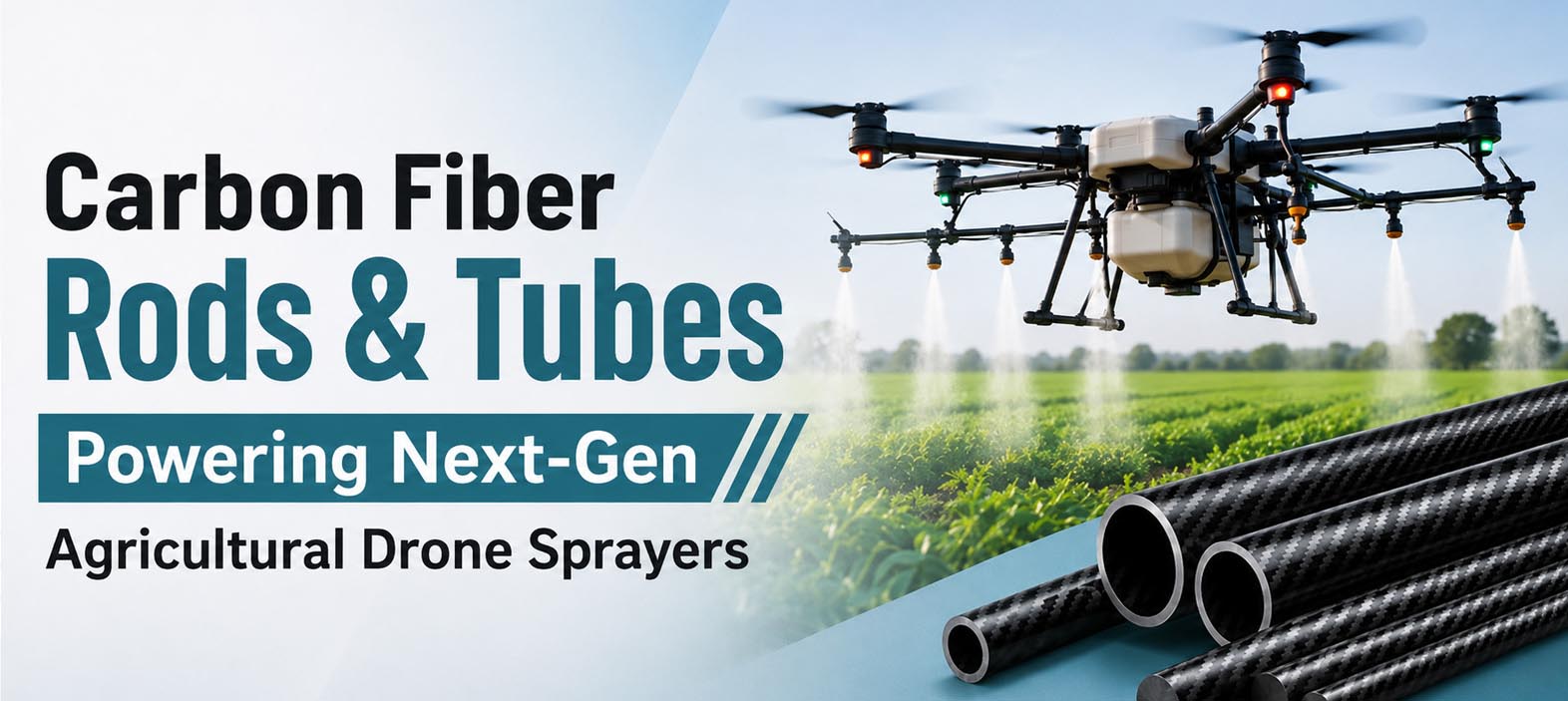
Agriculture drones are transforming how farms apply fertilizers and pesticides, and the market reflects that shift clearly. The Indian agriculture drones market reached USD 302.3 million in 2025 and is projected to reach USD 2,185.5 million by 2034, growing at a CAGR of 23.84 percent. Globally, the picture is even bigger. The crop spraying drones market is valued at USD 4.48 billion in 2026 and is projected to reach USD 13.88 billion by 2030, growing at a 32.7 percent CAGR.
This growth puts enormous pressure on drone manufacturers to build sprayer airframes that are light, strong, and reliable in the field. Carbon fiber composites come as a clear winner. The material choice behind the frame, arms, and booms of an agriculture drone is no longer a minor engineering decision. It is the difference between a sprayer that performs and one that fails under real farm conditions.
As the need of the hour, carbon fiber composites are coming up as the choice for drone OEMs. Carbon fiber rods, prepreg carbon fiber tubes, and CNC-machined carbon fiber parts are becoming the standard for agriculture drone sprayers, instead of aluminum or fiberglass.
The Payload and Flight Time Problem
Every gram added to an agriculture drone sprayer’s frame is a gram subtracted from payload capacity or flight time. A single drone operator can spray up to 50 acres a day, completing in minutes what once took an entire team hours. That efficiency depends entirely on the drone carrying a heavier tank of pesticide or fertilizer while staying airborne longer between charges.
Carbon fiber solves this problem at the material level. Carbon fiber rods and tubes offer one of the highest strength-to-weight ratios of any structural material available to drone manufacturers today. This means the airframe, arms, and boom structures can be built lighter without sacrificing the rigidity needed to carry a full spray tank and resist vibration from rotors and pumps.
Why Carbon Fiber Rods and Tubes Outperform Aluminum and Fiberglass
Aluminum is affordable and easy to machine, but heavier per unit of strength, prone to fatigue cracking under repeated vibration, and corrodes when exposed to fertilizers, pesticides, and moisture over repeated field use.
Fiberglass is lighter than aluminum but lacks the stiffness needed for booms and arms that must stay rigid under rotor torque and payload sway during spraying runs. Flex in the boom translates directly into spray-pattern inconsistency, which affects field coverage and increases chemical waste.
Carbon fiber rods and both prepreg and pultruded carbon fiber tubes address both weaknesses. They combine high stiffness with low weight, resist corrosion from agrochemicals completely, and maintain dimensional stability across repeated flight cycles. For a sprayer drone that may fly multiple missions a day across a full agricultural season, this durability translates directly into lower maintenance costs and fewer frame replacements.
|| Also Read: Why Carbon Fiber is a preferred material for making Drones?
Where Carbon Fiber Components Fit in a Sprayer Drone
In agriculture drone sprayer manufacturing, carbon fiber rods and tubes are used across several critical structural points.
- Drone arms and booms benefit most directly. Pultruded carbon fiber tubes provide the rigidity needed to keep motors aligned and spray nozzles stable, even as the drone carries a full tank and maneuvers across uneven field terrain.
- Landing gear and frame supports also benefit from carbon fiber rods, where high stiffness and low weight reduce stress on the airframe during repeated takeoffs and landings on rough agricultural ground.
- CNC-machined carbon fiber parts allow drone manufacturers to integrate precision mounts, brackets, and connector housings directly into the frame design. This reduces the number of separate metal fasteners and joints, further lowering total weight and reducing points of mechanical failure in the field.
Prepreg carbon fiber tubes, built with multiple layups of unidirectional and multi-directional fiber, are particularly suited to boom arms and telescopic structures where bending stiffness under load is critical to spray accuracy.
Building the Next Generation of Agriculture Sprayer Drones
As agriculture drones move from early adoption to mainstream farm equipment, the manufacturers who win will be the ones building frames that are lighter, stiffer, and more durable in real field conditions. Carbon fiber rods, tubes, and CNC-machined parts are no longer a premium upgrade. They are becoming the baseline expectation for serious agriculture drone sprayer manufacturers.
For OEMs developing the next generation of spraying UAVs, choosing the right carbon fiber components early in the design process determines how well that drone performs across thousands of flight hours in the field.
Explore Agriculture drone sprayers parts with NitPro Composites. Inquire for pultruded and prepreg carbon fiber tubes, carbon fiber rods, and CNC-machined carbon fiber parts in customized shapes & designs for agricultural spraying UAVs.
Frequently Asked Questions
Q1. Why is carbon fiber used in agriculture drone sprayers?
A. Carbon fiber is used in agricultural drone sprayers because it offers an exceptional strength-to-weight ratio, which increases payload capacity and flight time while maintaining the rigidity needed for stable spraying performance.
Q2. What carbon fiber components are used in drone sprayer manufacturing?
A. Drone sprayer manufacturers commonly use carbon fiber rods for structural supports, carbon fiber tubes for arms and booms, and CNC-machined carbon fiber parts for precision mounts, brackets, and connector housings.
Q3. Is carbon fiber better than aluminum for drone frames?
A. Carbon fiber generally outperforms aluminum in drone frames because it offers higher stiffness per unit weight, resists corrosion from agrochemicals, and does not suffer the same fatigue cracking under repeated vibration that aluminum does.
Q4. How does carbon fiber improve agriculture drone payload capacity?
A. By reducing the weight of the airframe, arms, and boom structures, carbon fiber allows more of the drone’s total lift capacity to be allocated to the spray tank, increasing the volume of pesticide or fertilizer that can be carried per flight.
Q5. What is the difference between pultruded and prepreg carbon fiber tubes for drones?
A. Pultruded carbon fiber tubes use continuous unidirectional fiber and suit structural arms and booms requiring straightforward rigidity. Prepreg carbon fiber tubes use multiple layups of directional fiber for higher bending stiffness, making them well suited to telescopic and load-bearing boom structures.