
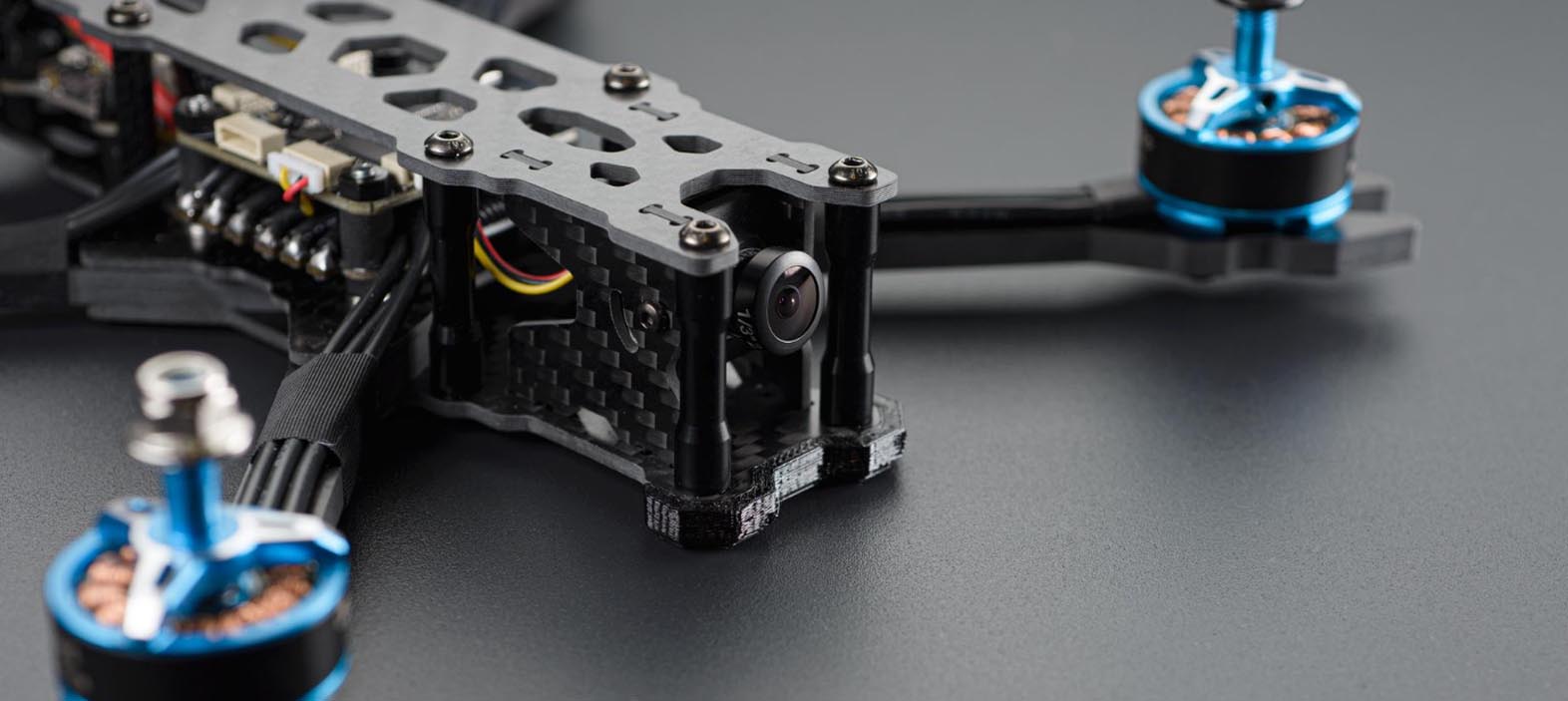
The best material for a drone frame isn’t the lightest one available; it’s the one that makes everything else perform better. When planning to build drone frames and parts at any serious scale, the pressure is to build a frame that can fly longer, carry more, survive tougher conditions, and still keep the airframe light enough to matter. That’s not one engineering problem — it’s four, competing against each other, every time you spec a frame.
Material selection is where those problems either get solved or get passed downstream. And increasingly, drone manufacturers across commercial, industrial, and defense sectors are arriving at the same answer: carbon fiber composites and specifically pultruded carbon fiber tubes.
NitPro Composites understands the evolving demands of the drone industry and stands as a leading manufacturer, supplier, and exporter of precision-engineered carbon fiber products. Offering fully customized sizes and specifications, NitPro Composites delivers lightweight, high-strength solutions tailored to meet the exacting performance standards of modern drone applications. From structural components to specialized parts, every product is crafted with superior material quality and engineering expertise, making us the trusted partner for drone manufacturers worldwide.
What Makes Pultruded Carbon Fiber Tubes Different?
Carbon fiber comes in several forms. What sets pultruded tubes apart is the manufacturing process itself.
In pultrusion, continuous fiber tows are pulled through a resin bath and a heated die in a single, continuous operation. The result is a tube with highly aligned fibers running axially along its length and that alignment is everything.
It delivers:
- Superior axial strength and stiffness
- Highly predictable mechanical behavior
- Excellent dimensional consistency across production runs
- Low weight with high structural rigidity
- Cost efficiency at scale, because the process is continuous
These properties make pultruded carbon fiber tubes ideally suited to drone frame components that face bending, axial tension, and vibration loads, which is most of the frame.
Why the Industry Is Moving to Carbon Fiber Composites
As drone manufacturers’ demand endurance, heavier payloads, and more demanding operating environments that ceiling becomes a constraint rather than a specification.
Here’s what’s driving the shift to carbon fiber for drone frames:
Strength-to-weight ratio – Pultruded carbon fiber offers significantly higher longitudinal stiffness and strength per gram than aluminum or titanium. That mass reduction compounds across the aircraft: lighter arms mean less motor load, which means smaller batteries, which means the weight savings multiply rather than simply add.
Fatigue resistance – Drone airframes endure thousands of vibration cycles from rotors, repeated takeoff and landing shocks, and dynamic flight loads. Pultruded composites maintain their mechanical properties under cyclic loading far better than metals, delaying micro-cracking and extending airframe service life.
Environmental stability – Unlike aluminum, carbon fiber doesn’t corrode. It holds its structural properties in high humidity, marine environments, desert heat, and sub-zero conditions — making it the material of choice for industrial inspection, offshore energy, and defense applications where all-condition reliability is non-negotiable.
Lifecycle cost – The upfront material cost of carbon fiber is higher. But when you factor in reduced maintenance, fewer replacements, and lower corrosion-related failures, the total cost of ownership frequently favors composites — particularly across commercial OEM programs at scale.
Where Pultruded Tubes Deliver the Most Value in a Drone Frame
Not every component benefits equally. The highest return on carbon fiber integration comes from placing tubes precisely where structural loads are greatest.
Arms and booms – In multirotor platforms, the arms connecting motors to the central frame are the primary bending load path. Pultruded tubes here reduce flex, lower vibration transfer, and improve flight controller stability, particularly for drones carrying sensitive sensors or cameras.
Spars and longerons on fixed-wing UAVs – Wing spars and fuselage longerons benefit directly from the axial stiffness of pultruded profiles, improving structural efficiency across the entire wingspan.
Hybrid torsion-resistant joints – Pultruded tubes are weakest in torsion due to their unidirectional fiber alignment. The practical solution used by leading OEMs is to pair pultruded tubes with roll-wrapped connectors, braided sleeves, or molded composite joints at critical intersections. This preserves torsional rigidity without adding mass.
Modular frame architectures – Because pultruded tubes come in standardized diameters and can be cut to length, they support rapid prototyping, easy field replacement, and simplified assembly lines — a growing priority for manufacturers scaling to global commercial deployment.
Engineering Trade-Offs to Plan For
Pultruded carbon fiber performs best when its constraints are understood and designed around from the start.
Directional load alignment. Unidirectional fiber alignment means peak strength is axial. Torsional and off-axis loads require supplementary reinforcement. Map your load paths early and identify where hybrid composites are needed.
Geometry limitations. Pultrusion produces constant cross-sections. Components requiring curves, tapers, or complex contours need filament-wound or roll-wrapped alternatives. Design your frame architecture with this in mind.
Customization vs. cost. Standard pultruded tubes are highly cost-efficient at volume. Aerospace-grade customization — specialist resin systems, high-temperature matrices, or complex interface geometries — may require hybrid manufacturing solutions and should be scoped with your composite supplier early.
Conclusion
The performance demands on modern UAV platforms are only increasing. Longer endurance, heavier payloads, harsher environments, and tighter cost targets are no longer aspirational specs — they’re market requirements. Pultruded carbon fiber tubes give drone manufacturers a direct, well-understood path to meeting them.
The manufacturers who integrate these materials systematically — with proper load mapping, hybrid joint design, and lifecycle validation — will build lighter, stronger, more reliable airframes than those who treat material selection as a secondary decision.
Carbon fiber drone frame design is no longer a differentiator for high-end programs alone. It is increasingly the baseline for any UAV platform built to compete.
How NitPro Composites Help in Drone Manufacturing
NitPro Composites works directly with UAV engineering teams to supply precision-engineered pultruded profiles, custom resin systems, and composite design expertise. Whether you’re optimizing an existing platform or developing a new one from the ground up, we can support your team from material selection through production scaling.
FAQs: Carbon Fiber Tubes for Drone Frames
1. Why is carbon fiber used in drones rather than other materials?
A. Carbon fiber offers the best combination of strength, stiffness, and low weight available to drone engineers. For UAV applications where every gram affects flight time and payload capacity, no other structural material delivers comparable performance at a practical cost.
2. What is the best material for a drone frame?
A. For most commercial, industrial, and defense UAV applications, pultruded carbon fiber tubes represent the best balance of structural performance, environmental durability, and lifecycle cost. Aluminum remains practical for low-cost consumer platforms; titanium is reserved for extreme-load defense applications where cost is secondary.
3. How do carbon fiber tubes make a drone more lightweight?
A. Carbon fiber has a higher strength-to-weight ratio than aluminum or titanium, meaning you get the same — or greater — structural rigidity at significantly lower mass. Lighter arms and structural members reduce the load on motors and batteries, which allows further weight reduction across the drivetrain in a compounding effect.
4. What are UAV carbon fiber tubes used for specifically?
A. The primary applications are motor arms, fuselage booms, wing spars, longerons, and structural cross-members. These are the components that carry the highest bending and axial loads during flight.
5. Are pultruded tubes suitable for both multirotor and fixed-wing UAVs?
A. Yes. Multirotor drones use them primarily in arms and booms; fixed-wing platforms use them in spars and longerons. The same material properties — axial stiffness, fatigue resistance, and low weight- benefit both architectures.
6. What is the difference between pultruded and roll-wrapped carbon fiber tubes?
A. Pultruded tubes have highly aligned axial fibers and excel in longitudinal strength and bending stiffness. Roll-wrapped tubes have multi-angle fiber layers and offer better torsional resistance. Many OEMs use pultruded tubes for structural members and roll-wrapped or braided composites at joints, combining the strengths of both.