
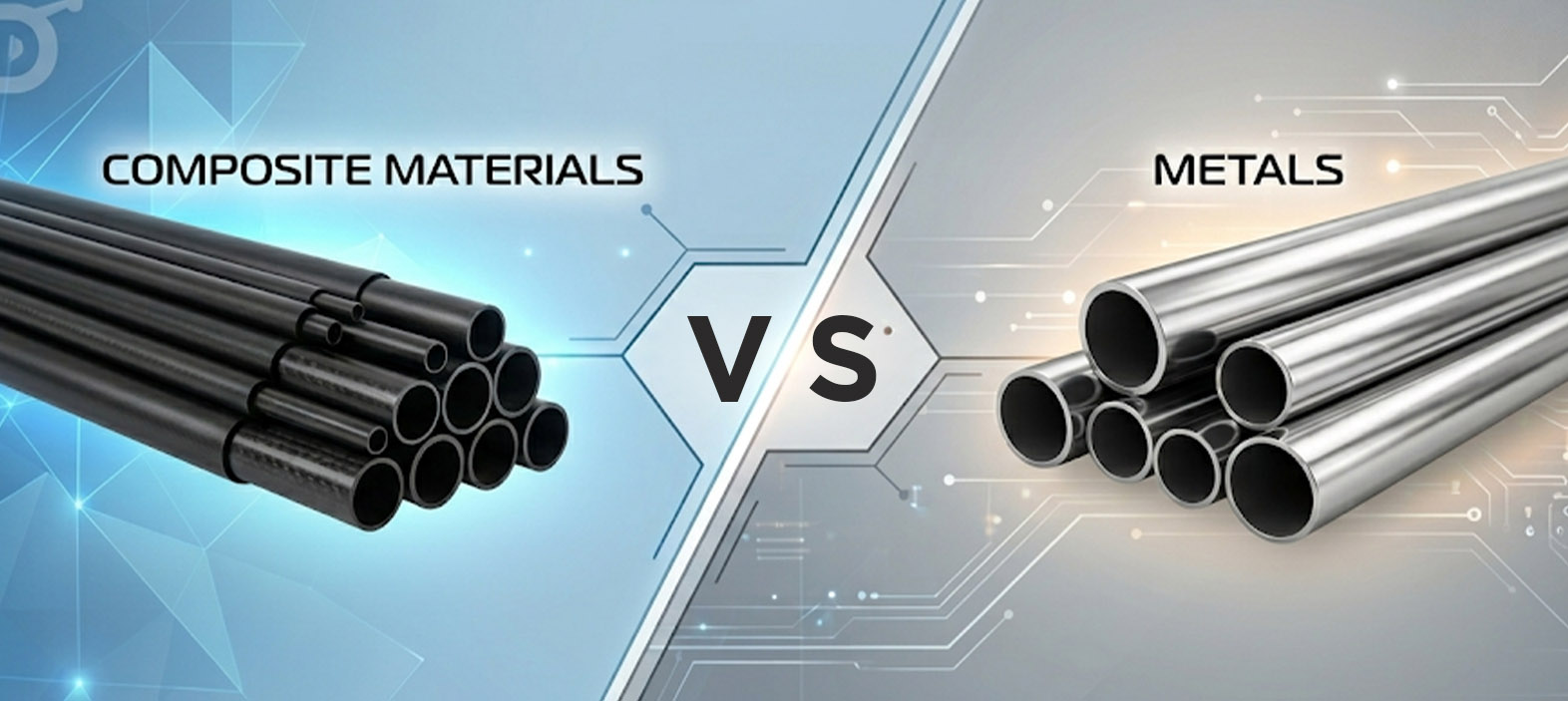
The drone industry is evolving at breakneck speed. From precision agriculture and infrastructure inspection to defense surveillance and last-mile delivery, UAVs are now mission-critical tools across every major sector. And as performance demands intensify, one question sits at the heart of every UAV engineering decision: which material do you build with?
For years, metals, primarily aluminum alloys, were the default choice. Reliable, machinable, affordable. But as payload requirements grow and flight endurance becomes a competitive differentiator, the industry is making a decisive shift toward composite materials and carbon fiber composites in particular.
The Contenders in Drone (UAV) Manufacturing
In UAV manufacturing, composite materials typically refer to Carbon Fiber Reinforced Polymer (CFRP), carbon fiber embedded in a polymer resin matrix. Variants include:
- Unidirectional (UD) carbon fiber — maximum stiffness in one axis; used in spars and load-bearing beams
- Woven carbon fiber (plain, twill, satin weaves) — balanced biaxial properties; ideal for skins and complex curved surfaces
- Carbon fiber + aramid (Kevlar) hybrid — improved impact tolerance while retaining lightness
- Glass Fiber Reinforced Polymer (GFRP) — a cost-effective composite alternative for non-structural components
The primary metals used in UAV manufacturing include:
- Aluminum alloys — 6061-T6 and 7075-T6 are the most common; lightweight relative to steel, machinable, affordable
- Titanium — exceptional strength-to-weight, excellent fatigue life, but expensive and difficult to machine
- Magnesium alloys — among the lightest structural metals, but prone to corrosion
- Steel — high strength but too heavy for most airframe applications
For this comparison, we’ll focus primarily on aluminum vs carbon fiber drone frames, as these represent the most common real-world decision drone manufacturers face.
Head-to-Head: Composite vs Aluminum Drone Manufacturing
1. Strength-to-Weight Ratio in Drones
This is where carbon fiber composites win emphatically and without contest.
CFRP has a tensile strength of approximately 3,500 MPa and a density of just 1.6 g/cm³. Compare that to 7075 aluminum at roughly 572 MPa tensile strength and 2.81 g/cm³ density.
The result: carbon fiber composites deliver more structural strength at less than 60% of the weight of aluminum for an equivalent cross-section. When you scale this across an entire UAV airframe of frame arms, central body, landing gear, and motor mounts, the mass savings are transformative.
A structure of equal strength built from CFRP can weigh up to 5 times less than an equivalent steel or metal structure and significantly less than aluminum. Every kilogram saved from the airframe is a kilogram that can be redirected to battery capacity, payload, or extended flight time.
2. Stiffness and Vibration Damping
High stiffness matters enormously in drones. A flexing frame introduces vibration into the camera gimbal, disrupts IMU sensor readings, and reduces control precision.
Carbon fiber composites offer exceptional stiffness (elastic modulus of ~70–140 GPa depending on fiber grade), rivaling or exceeding aluminum in directional stiffness while weighing far less.
Critically, CFRP also offers natural vibration-damping properties that aluminum cannot match. A carbon fiber frame absorbs and dissipates vibration rather than transmitting it. This protects payloads, extends motor bearing life, and improves stabilization system performance.
3. Corrosion and Environmental Resistance
Aluminum is vulnerable to galvanic corrosion, especially when in contact with dissimilar metals. Marine inspection drones, agricultural drones operating in humid environments, and infrastructure drones used in coastal conditions all face accelerated degradation with aluminum frames.
Carbon fiber does not corrode. CFRP is chemically inert, stable across a wide temperature range, and unaffected by moisture, saltwater, fertilizers, or industrial chemicals. For drones deployed in harsh operating environments, this translates directly into longer service life and lower maintenance costs.
4. Design Flexibility and Geometric Complexity
One of the most underappreciated advantages of composite materials for drones is the freedom of form.
Aluminum is constrained by machining and extrusion processes. Carbon fiber composites can be molded into virtually any geometry. Layup processes, resin transfer molding (RTM), and vacuum infusion allow drone engineers to integrate structural and aerodynamic functions in a single part, reduce part count and assembly joints (each joint is a potential failure point and a weight penalty) and design for optimal fiber orientation in each load direction.
5. Fatigue Life
Aluminum is susceptible to fatigue cracking under repeated cyclic loading, which is a critical concern in drone arms and motor mounts that endure thousands of vibration cycles per flight hour.
CFRP exhibits outstanding fatigue resistance. The fiber-matrix interface effectively arrests crack propagation, giving carbon fiber components a fatigue life that typically far exceeds equivalent aluminum parts in UAV operating conditions.
6. Radar Signature (Defense and Surveillance UAVs)
For defense, intelligence, and persistent surveillance applications, material radar reflectivity is a decisive factor.
Carbon fiber composites have inherently low radar cross-section (RCS) compared to aluminum, which is highly reflective to radar. CFRP can be further engineered with radar-absorbing matrix systems or surface treatments for low-observable UAV platforms.
Aluminum airframes are fundamentally incompatible with stealth requirements. This is one reason CFRP dominates military and defense UAV construction globally.
7. Cost
Let’s be direct about this. Aluminum wins on raw material cost and ease of processing.
Carbon fiber materials are more expensive, typically 5 to 25 times and significantly more than aluminum per kilogram. Processing also requires specialized tooling, autoclaves or vacuum infusion setups, and skilled composite technicians. However, the total cost calculation changes at over carbon fiber composite product lifetime.
Lower maintenance, longer service life, improved energy efficiency (smaller battery for equivalent range), and reduced payload cost all offset initial material expenditure for professional-grade UAVs.
UAV Manufacturing Materials: What Each Drone Segment Chooses — and Why |
||
UAV Segment |
Typical Frame Material |
Primary Driver |
Consumer/hobbyist |
Aluminum, ABS plastic |
Cost, crash repairability |
Professional photography |
CFRP with aluminum joints |
Weight, vibration damping |
Agricultural sprayer UAV |
CFRP primary structure |
Payload, endurance, chemical resistance |
Delivery/logistics drone |
CFRP airframe |
Payload-to-weight efficiency |
Fixed-wing mapping UAV |
CFRP skins, foam core |
Aerodynamic efficiency, endurance |
Tactical/defense UAV |
CFRP throughout |
Low RCS, weight, fatigue life |
HALE (high-altitude) |
CFRP primary structure |
Extreme weight sensitivity |
NitPro Composites: Your Composite Materials Partner for UAV Manufacturing
As a dedicated carbon fiber manufacturer, supplier, and exporter, NitPro Composites understands the specific demands of UAV and drone manufacturing.
- Carbon fiber sheets and panels in standard and custom layup configurations
- Carbon fiber tubes and rods for frame arms, spars, and structural members
- Woven and unidirectional CFRP prepregs for in-house lamination
- CNC-machined components for airframes, motor mounts, payload bays, and landing gear structures
We work with drone manufacturers across commercial, industrial, and defense segments, from prototype development to production-scale supply. Contact our technical team to discuss material specifications, custom component supply, and bulk pricing for your drone manufacturing program.
FAQs
1. Why are composite materials preferred over metals in drone manufacturing?
A. Composite materials like carbon fiber offer a superior strength-to-weight ratio, making drones lighter, more efficient, and capable of longer flight times compared to metal-based structures.
2. How do carbon fiber composites improve drone performance?
A. Carbon fiber composites provide high stiffness, excellent vibration damping, and fatigue resistance, resulting in better flight stability, improved sensor accuracy, and longer component lifespan.
3. Are metals like aluminum still used in drone manufacturing?
A. Yes, aluminum is still used in cost-sensitive or entry-level drones due to its affordability and ease of machining, but it is heavier and less efficient than composite materials.
4. What are the cost differences between composite materials and metals in UAVs?
A. Composite materials are more expensive upfront than metals like aluminum, but they offer long-term benefits such as reduced maintenance, improved durability, and better energy efficiency.