
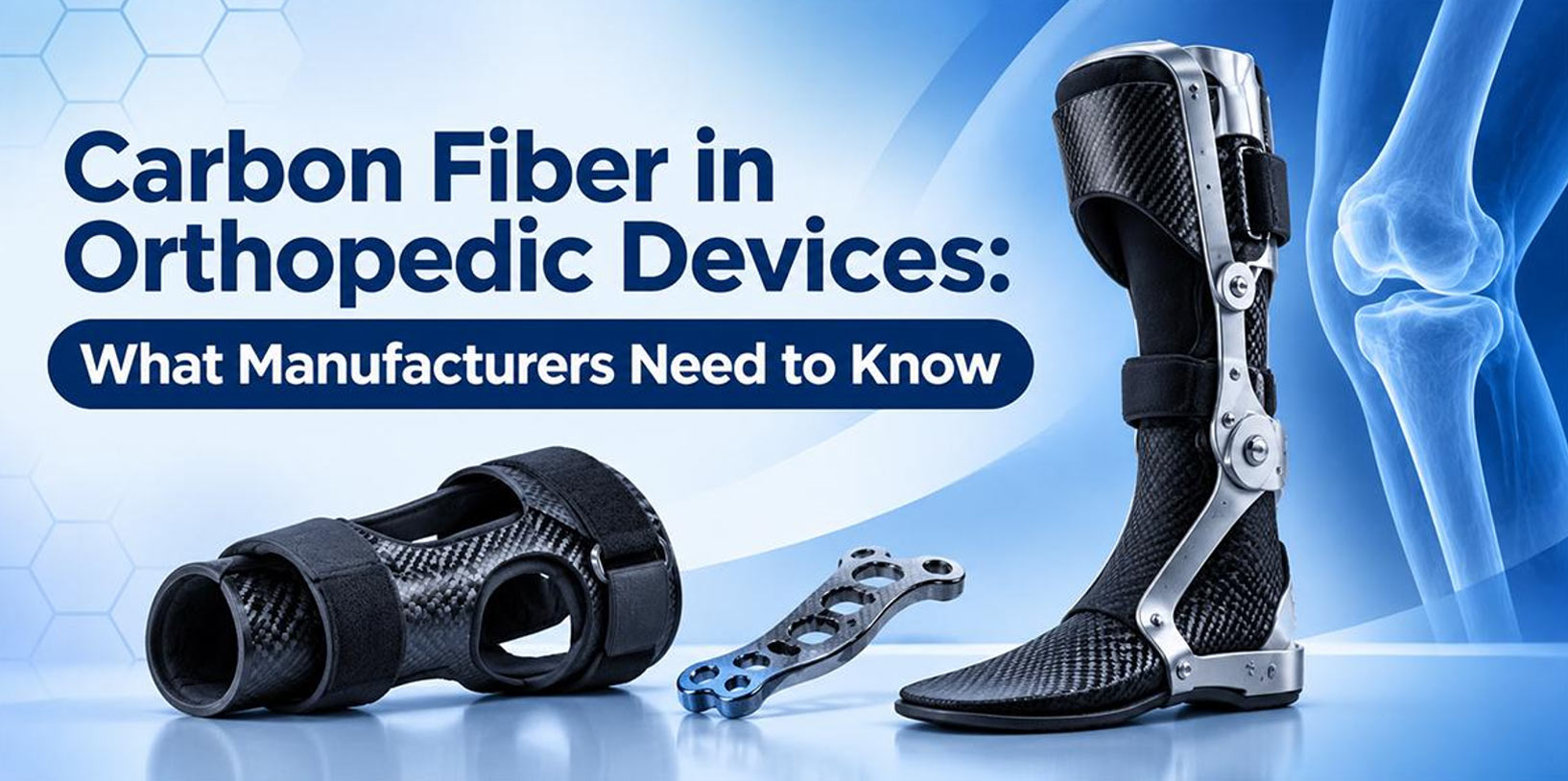
Orthopedic device makers face constant pressure to deliver products that are lighter, stronger, and more comfortable for patients. Carbon fiber is a state-of-the-art answer to that pressure, thanks to its high strength-to-weight ratio, fatigue resistance, and, with the right resin system, biocompatibility. At NitPro Composites, we manufacture carbon fiber tubes, rods, sheets, and CNC-machined parts for many industries. The medical industry, especially orthopedic device manufacturers, understands what carbon fiber material requirements should look like.
Why Are Carbon Fiber Composites Used in Orthopedic Devices?
Carbon fiber (CFRP) is used in orthopedic devices because it combines a high strength-to-weight ratio, fatigue resistance, and radiolucency, so it does not obstruct X-ray or CT imaging. These properties make carbon fiber orthopedic components lighter for patients, durable under repeated loading, and compatible with diagnostic workflows.
Compared with metals, carbon fiber composites also resist corrosion and can be engineered for specific stiffness and flex. A prosthetic component can be made rigid where it needs support and compliant where it needs energy return. That tunability is difficult to achieve with metal alloys. To see how this applies to real products, explore our carbon fiber orthopedic parts.
Key Material Requirements for Orthopedic Carbon Fiber Parts
- Mechanical Performance: Orthopedic parts face cyclic loading, bending, and torsion every day. Define the stiffness, flexural strength, and fatigue life you need up front. Fiber orientation, layup, and resin content all shape the result, so specify them in your drawings or work with experienced manufacturers to engineer the laminate. CFRP unidirectional layers resist bending along the length, while angled layers improve torsional strength.
- Radiolucency and Imaging Compatibility: For surgical table components, imaging accessories, and fixation frames, clear imaging matters. Carbon fiber’s low X-ray attenuation helps reduce the artifacts that metal components can create, giving surgeons and radiologists a cleaner view during procedures and follow-up.
- Biocompatibility and Sterilization: If a device contacts skin or tissue, or must be reprocessed, material choice goes beyond the fiber. The resin system, surface finish, and any coatings must suit your biocompatibility strategy and your sterilization method, whether autoclave, gamma, or ethylene oxide. Regulatory responsibility rests with the device manufacturer, so document these requirements early.
- Dimensional Accuracy and Consistency: Orthopedic assemblies rely on tight fits. Define tolerances for wall thickness, inner and outer diameter, straightness, and flatness. Expect batch-to-batch repeatability and traceable material records from your supplier, since consistency is what makes validation and scale-up possible.
Which Carbon Fiber Forms Suit Orthopedic Manufacturers?
Different devices call for different starting materials. Choosing the right form early reduces machining time, waste, and cost.
- Carbon fiber tubes: prosthetic pylons, orthotic frames, and instrument handles
- Carbon fiber rods: supports, struts, and lightweight instrument shafts
- Carbon fiber sheets: plates, footplates, and brace components
- CNC carbon fiber parts: complex geometries, holes, and slots machined to print
- Carbon fiber external fixator rings (full, half, 1/3, 1/4, 2/3, 3/4, 3/8, and 5/8)
- Carbon fiber Italian arches (90° and 120°)
Tubes and rods offer excellent stiffness along their length, which suits load-bearing structures. Sheets can be cut and shaped into flat or contoured components, while CNC machining turns these raw forms into finished parts that match your drawings exactly.
How to Choose a Carbon Fiber Supplier for Orthopedic Parts
The supplier you choose affects product quality, lead times, and regulatory readiness. Look for a custom carbon fiber manufacturer that can:
- Customize layups, diameters, and thicknesses
- Hold tight, documented tolerances
- Machine composites without delamination or fraying
- Provide material traceability and consistent quality
- Support prototypes as well as production volumes
It also helps to work with a team that understands engineering as well as manufacturing. A supplier that reviews your drawings, flags manufacturability issues early, and suggests layup improvements can save you costly redesigns later. Prototype support matters too, because testing a few samples before committing to full production reduces risk.
Partner with NitPro Composites
As a carbon fiber manufacturer serving medical, industrial, and sporting industries, NitPro Composites understands that orthopedic parts leave little room for error. Share your drawings and performance requirements, and our team will help you turn them into precise, repeatable carbon fiber components.
Whether you need a single prototype tube or a production run of CNC-machined parts, we are ready to help. Learn more about our capabilities on our carbon fiber orthopedic parts page and send us your requirements today.
Frequently Asked Questions
Q1. Why is carbon fiber used in orthopedic devices?
Ans. Carbon fiber combines high strength, low weight, and radiolucency, meaning it does not obstruct X-rays or CT imaging. It also resists fatigue and corrosion, making it ideal for prosthetics, orthoses, surgical instruments, and imaging accessories where durability, patient comfort, and clear diagnostic visibility all matter.
Q2. Is carbon fiber biocompatible?
Ans. Cured carbon fiber composites are generally chemically stable, but biocompatibility depends on the resin system, fiber, and finishing. Devices touching tissue need testing under ISO 10993. Manufacturers should specify requirements early so suppliers can document materials and processing, and support your regulatory and validation work.
Q3. Which carbon fiber forms suit orthopedic manufacturers?
Ans. Tubes suit prosthetic pylons and orthotic frames, rods work for supports and instrument shafts, sheets are machined into plates and footplates, and CNC-machined parts deliver complex geometries. NitPro Composites supplies all four, with custom layups, wall thicknesses, and tolerances tailored for your exact design requirements.
Q4. How does fiber orientation affect performance?
Ans. Fiber orientation controls stiffness, strength, and flex. Unidirectional layers resist bending along the length, while ±45° layers improve torsional strength. Balanced layups let manufacturers precisely tune devices, such as dynamic prosthetic components, for the load paths and patient daily activity levels they must reliably handle.