
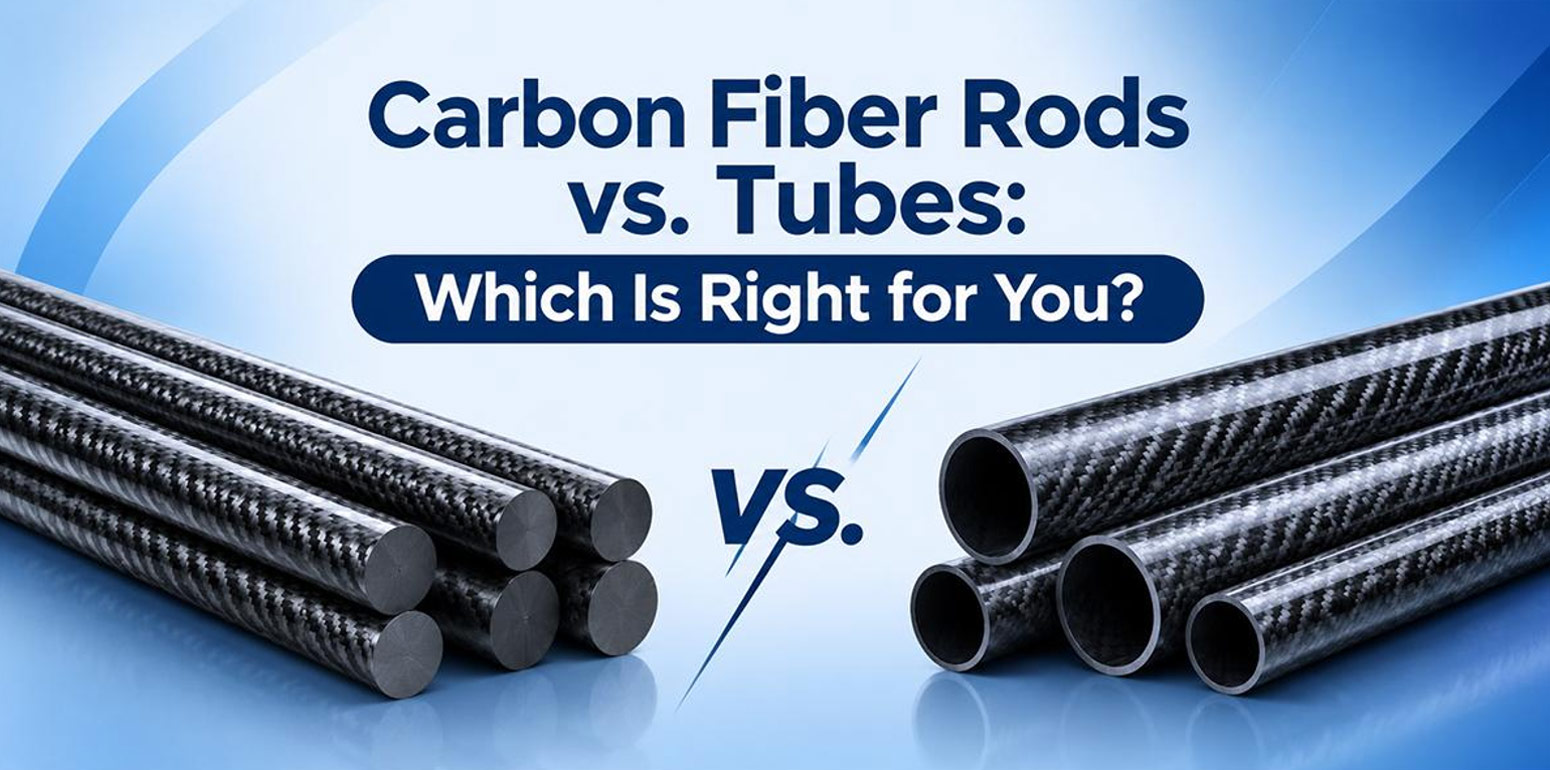
If you’re specifying carbon fiber components for a product design, one of the first decisions is geometry: solid rod or hollow tube? Both are made through pultrusion, both deliver exceptional strength-to-weight ratios, and both can look interchangeable on a drawing. In practice, they behave very differently under load.
At NitPro Composites, we manufacture carbon fiber pultruded products for OEMs and manufacturers across industries. Here’s how we help engineering and procurement teams choose between carbon fiber pultruded rods and carbon fiber tubes.
What Is the Difference Between Carbon Fiber Rods and Tubes?
A carbon fiber pultruded rod is a solid, continuous profile made by pulling carbon fiber reinforcement through a resin bath and a heated die. The result is a dense, unidirectional composite with fibers running along the length of the part.
A carbon fiber tube has a hollow cross-section. It can be pultruded for straight, unidirectional-dominant profiles, or made by roll wrapping or filament winding when you need fibers at multiple angles.
The short answer: rods maximize tensile strength and stiffness per unit of cross-section, while tubes maximize bending and torsional stiffness per unit of weight.
Carbon Fiber Rods vs. Tubes: Quick Comparison
Factor |
CFRP Pultruded Rod |
CFRP Pultruded Tube |
Tensile strength |
Excellent |
Good |
Bending stiffness (per weight) |
Good |
Excellent |
Torsional rigidity |
Moderate |
High (with angled plies) |
Weight |
Heavier per length |
Lighter per length |
Cost per foot |
Typically lower |
Typically higher |
Fiber orientation |
Primarily 0° |
0° to multi-angle |
Best for |
Tension, compression, pins, stiffeners |
Booms, shafts, frames, rollers |
When to Choose Carbon Fiber Pultruded Rods
Solid rods are the right choice when your application demands high axial strength and stiffness in a compact footprint.
Choose rods for:
- Tension members and cable-replacement applications, where unidirectional fibers carry load efficiently
- Reinforcement and stiffening elements embedded in larger structures, such as wind blade spar caps, sporting goods, and molded parts
- Small-diameter applications where a tube wall would be too thin to manufacture reliably
- Pins, dowels, and alignment components that need high compressive strength and fatigue resistance
- Cost-sensitive, high-volume production, since pultrusion of solid profiles is highly efficient and repeatable
Because rods are solid, they also tolerate point loads, clamping, and machining better than thin-walled tubes. They are less likely to crush or crack under a fastener.
When to Choose Carbon Fiber Tubes
Material placed farther from the neutral axis does more work in bending. That’s why tubes outperform rods of equal weight in bending and buckling resistance.
Choose tubes for:
- Long-span structures such as booms, masts, and support arms where deflection must be minimized
- Rotating shafts and rollers, where low mass and high torsional stiffness reduce inertia and energy use
- Robotics and automation end-of-arm tooling, where every gram saved improves cycle time
- UAV and drone frames, where weight is critical and tubes double as structural members
- Applications that route wiring, fluids, or sensors through the hollow core
If you need torsional rigidity, ask about tubes with ±45° fiber layers. A purely unidirectional tube resists bending well but twists easily.
How Do You Choose Between a Carbon Fiber Rod and a Tube?
Ask these five questions:
- What is the primary load: tension, bending, or torsion? Tension favors rods. Bending and torsion favor tubes.
- How critical is weight? A tube of the same outer diameter can weigh significantly less than a solid rod.
- What is the span length? Longer unsupported lengths benefit from the higher section modulus of a tube.
- How will it be joined or fastened? Rods handle bonded, clamped, and drilled connections more forgiving than thin-walled tubes. Tubes may need bonded inserts or end fittings.
Common Mistakes When Specifying Carbon Fiber Profiles
- Choosing a rod just because it’s “stronger.” Solid isn’t always stiffer where it matters. In bending, a tube often wins.
- Ignoring fiber orientation. Pultruded profiles are strong along the axis but weaker across it. Design loads accordingly.
- Over-tightening clamps on thin-walled tubes. Crush damage is a leading cause of field failures. Specify reinforced clamp zones or inserts.
- Overlooking environmental factors. UV exposure, moisture, and operating temperature all affect resin selection.
Custom Carbon Fiber Rods and Tubes from NitPro Composites
NitPro Composites works directly with manufacturers to deliver custom carbon fiber pultruded rods, tubes, and profiles built to specification. Our engineering team can review your load case and recommend the most cost-effective geometry, so you’re not paying for performance you don’t need or risking a part that underperforms.
The best choice between a carbon fiber rod and a tube comes down to load type, weight targets, joining method, and budget. Getting it right early saves redesign cycles and production cost.
Frequently Asked Questions
Q1. Are carbon fiber rods stronger than carbon fiber tubes?
Ans. In pure tension, a solid rod carries more load because it has more material. In bending and buckling, a tube is often stiffer and stronger per unit of weight.
Q2. Are carbon fiber tubes lighter than rods?
Ans. Yes. A hollow section removes weight from the center of the profile, where material contributes least to bending stiffness.
Q3. Which is cheaper, a carbon fiber rod or a tube?
Ans. Rods are usually less expensive per foot. Tubes can reduce total system cost when weight savings allow lighter supporting structures.
Q4. Can carbon fiber rods replace steel or aluminum?
Ans. In many applications, yes. Carbon fiber offers a far higher strength-to-weight ratio, along with corrosion and fatigue resistance. Joining methods and cost should be evaluated early.