
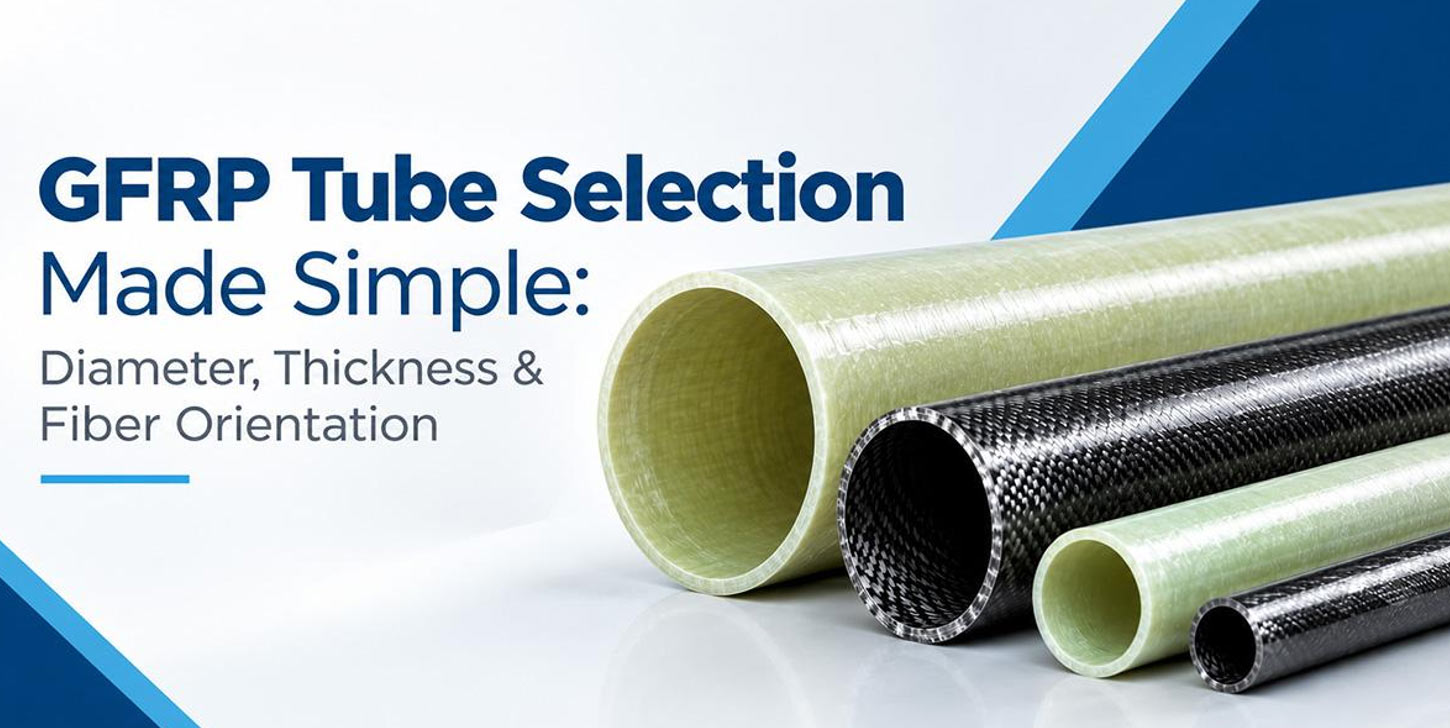
Glass fiber reinforced polymer (GFRP) tubes are increasingly used as lightweight alternatives to traditional materials in applications where strength, corrosion resistance and durability matter. However, selecting the right GFRP tube diameter, wall thickness and fiber orientation is critical to achieving the required structural performance.
From infrastructure and construction to electrical, chemical processing and transportation applications, the correct GFRP tube design depends on loads, environmental conditions, connection requirements and the intended service life. With NitPro Composites, you can get customized glass fiber composite tubes in diameter, wall thickness, fiber orientation, sizes and quantity according to your use. From OEMs to small-scale manufacturers, get high-quality ISO-certified advanced fiber composite products.
This guide explains the key factors to consider when selecting GFRP tube dimensions and fiber orientation for structural applications.
What Are GFRP Tubes?
GFRP tubes are composite profiles made by combining glass fibers with a polymer resin matrix. The glass fibers provide strength and stiffness, while the polymer matrix binds the fibers together, transfers loads and provides protection against environmental exposure.
These advanced fiber composites can be manufactured using processes such as pultrusion, filament winding and other composite manufacturing techniques. The manufacturing method and fiber arrangement influence the final mechanical properties of the tube.
How Do You Select the Right GFRP Tube Diameter?
The GFRP tube diameter should be selected according to the loads, structural configuration and required stiffness of the application.
A larger diameter can increase the glass fiber tube’s resistance to bending and improve structural stiffness. However, increasing diameter can also affect weight, connections, clearances and overall system dimensions.
- Determine whether the tube will experience axial loads, bending, torsion, compression or a combination of these forces.
- Longer unsupported spans can require greater stiffness to control deflection. The tube diameter and wall thickness should therefore be evaluated together rather than independently.
- The selected diameter should accommodate the intended connection method, including bolted, bonded or mechanically assembled connections.
How Do You Choose GFRP Tube Wall Thickness?
GFRP tube wall thickness directly affects strength, stiffness, weight and material consumption. A thicker wall generally provides greater structural capacity, but simply increasing thickness is not always the most efficient solution.
Glass fiber composite tubes can often be engineered by strategically arranging fibers in directions that correspond to the loads. Safety factors and applicable engineering standards should also be incorporated into the design.
Why Is Fiber Orientation Important in GFRP Tubes?
Unlike isotropic metals, GFRP is an anisotropic composite material. Its mechanical properties depend significantly on the direction in which the reinforcing fibers are placed.
This makes fiber orientation in GFRP tubes one of the most important design considerations.
- Longitudinal Fibers – Fibers aligned along the tube’s length provide high longitudinal strength and stiffness. This orientation is particularly useful for applications involving axial loading and bending.
- Circumferential Fibers – Fibers oriented around the circumference can improve resistance to hoop stresses. They are particularly relevant for tubes exposed to internal or external pressure.
- ±45-Degree Fibers – Fibers positioned at approximately ±45 degrees can contribute to shear and torsional performance.
- Hybrid Fiber Orientations – Many applications benefit from a combination of longitudinal, circumferential and angled fibers. A GFRP tube with optimized fiber orientation can therefore be engineered to balance axial, bending, hoop and torsional requirements.
GFRP Tube Applications and Industries
The combination of lightweight construction, corrosion resistance and customizable mechanical properties allows glass fiber composites to serve a wide range of industries.
- Construction and Infrastructure – GFRP tubes can be used in structural frameworks, reinforcement systems, bridges, walkways and other infrastructure where corrosion resistance and low weight are valuable.
- Electrical and Utilities – Because GFRP is electrically insulating, composite tubes can be used in electrical infrastructure and utility applications where non-conductive structural components are required.
- Chemical Processing – GFRP’s resistance to many corrosive environments makes it suitable for chemical plants, wastewater facilities and industrial installations.
- Marine and Offshore – In marine environments, where saltwater exposure can accelerate metal corrosion, GFRP tubes can provide a durable lightweight alternative for selected structural applications.
- Transportation – The low weight of GFRP can help engineers develop lightweight components for transportation and mobility applications.
Key Considerations When Selecting GFRP Tube Dimensions
There is no single GFRP tube diameter and wall thickness that works for every application. The selection process should consider the entire structural system.
A practical design approach is to:
- Define the applied loads and load combinations.
- Establish allowable deflection and strength requirements.
- Select an initial tube diameter.
- Determine an appropriate wall thickness.
- Optimize fiber orientation according to the load direction.
- Evaluate buckling and connection requirements.
- Consider temperature, moisture, chemicals and other environmental factors.
- Validate the design using appropriate composite engineering analysis and testing.
The final specification should be reviewed by a qualified engineer and verified against applicable design standards.
Selecting the right GFRP tube diameter, wall thickness and fiber orientation is ultimately about matching the composite architecture to the application.
Glass fiber composites provide designers with the ability to engineer performance rather than simply selecting a material based on bulk properties. By balancing diameter, wall thickness, resin system and fiber orientation, manufacturers can develop GFRP tubes that deliver the required combination of strength, stiffness, weight and durability.
Whether used in construction, infrastructure, utilities, chemical processing, marine environments or transportation, NitPro Composites glass fiber composite tubes can provide an efficient solution where traditional materials may face challenges related to corrosion, weight or maintenance.
Frequently Asked Questions
1. How do you select GFRP tube diameter for structural applications?
GFRP tube diameter should be selected based on applied loads, span, support conditions, stiffness requirements, buckling resistance and connection geometry. Engineers should evaluate diameter together with wall thickness and fiber orientation to achieve the required structural performance.
2. What determines GFRP tube wall thickness?
Wall thickness depends on loading, bending, torsion, buckling, deflection, environmental exposure and required service life. A thicker wall may increase capacity, but optimized fiber orientation can often achieve required performance without unnecessary material or weight.
3. Why is fiber orientation important in GFRP tubes?
Fiber orientation determines directional mechanical properties. Longitudinal fibers improve axial and bending performance, circumferential fibers support hoop stresses, while angled fibers contribute to shear and torsional resistance in engineered composite tube designs.
4. Where are GFRP tubes commonly used?
GFRP tubes are used across construction, infrastructure, electrical utilities, chemical processing, marine, offshore and transportation industries. Their lightweight construction, corrosion resistance, electrical insulation and customizable fiber architecture make them suitable for demanding applications.