
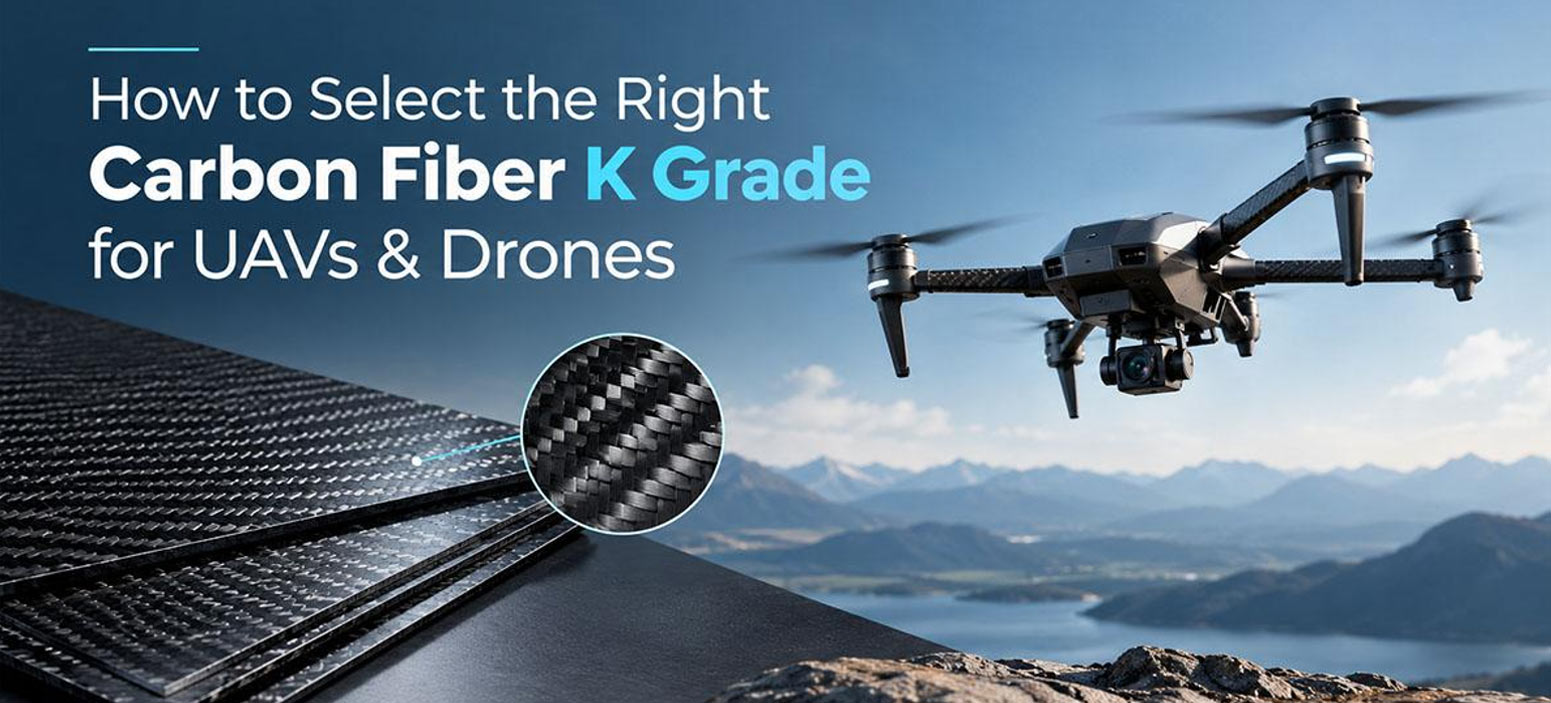
Choosing the right carbon fiber K grade for UAV and drone components depends on the weight, stiffness, strength, design, and manufacturing process. A higher K grade doesn’t mean stronger carbon fiber. K only tells you how many filaments sit in each tow. Strength and stiffness come from the fiber’s modulus, the weave or layup, and the resin system.
3K weaves are thinner and drape over tight curves with a fine, uniform surface, which makes them the usual choice for small frame plates and visible parts. 6K and 12K fabrics build thickness faster and cost less per kilo, which suits larger frames where budget and build time matter.
For arms, tubes, panels, and precision parts, match tow size to the part’s thickness, curvature, and production method rather than defaulting to the biggest number.
What Does K Stand For in Carbon Fiber Composites
K stands for kilo, meaning one thousand. It counts the filaments bundled into a single tow: 3K has about 3,000, 6K about 6,000, and 12K about 12,000. On a UAV, tow size changes the fabric’s thickness, drape, surface finish, and cost per kilo. It doesn’t change how strong the fiber itself is.
Tow size sets thickness and cost. Modulus, layup, and resin set strength. Modulus is the real stiffness lever. Standard-modulus fiber suits most drone frames, while intermediate and high-modulus grades add stiffness at higher cost.
Why Carbon Fiber Is Used in UAVs and Drones
Different parts of a drone take different abuse. Motor arms shake at high frequency, and chassis plates flex in hard maneuvers. Carbon fiber gives you a much higher stiffness-to-weight ratio than aluminum, which is why it shows up in most serious frames. A 3K sheet, for example, works well as the center plate of a small quad frame.
Common drone uses:
- Frames and center plates
- Arms and booms
- Structural tubes
- UAV panels
- Landing components
- Propeller components
- Precision CNC-machined parts
Read More: UAV vs Drone: Understanding the Terminology and Its Role in Component Sourcing
Matching Carbon Fiber K Grades to Drone Components
Each part of the drone wants something different from the fabric, so the right grade changes as you move from plates to arms to landing gear.
1. Frame Plates and Chassis Decks
3K sheet is the usual pick for center plates and top decks. The fine weave gives a clean, uniform surface and drapes over tight curves, so it also suits small frames and housings.
2. Arms, Booms, and Structural Tubes
Drone arms need high torsional stiffness to resist twisting during thrust bursts. Carbon fiber Prepreg tubes wrapped with ±45° twill take the twist, and unidirectional plies along the axis handle bending. Most arm tubes combine both, with 3K twill on the outer layer for a clean finish. Heavy-lift arms often go to 6K or 12K to build wall thickness faster. Where bending resistance is critical, pultruded carbon fiber tubes deliver continuous longitudinal strength.
3. Landing Gear and Support Struts
Landing gear takes sudden impacts. Solid carbon fiber rods make stiff, lightweight legs, but carbon is brittle, so pair them with compliant mounts or damping to soak up hard landings. K grade matters little here. Rod diameter and fiber orientation decide how the leg performs.
Breakdown of K Grades for Drone Builders
K Grade |
Filaments per Tow |
Key Characteristics |
Recommended UAV Usage |
1K |
1000 |
Thinnest fabric, finest weave, highest cost per kilo |
Micro drones, ultra-light wing skins, aesthetic covers |
3K |
3000 |
Fine weave, tight drape, clean surface finish |
Small to mid-size drone frames, top/bottom plates, motor mounts |
6K |
6000 |
Thicker fabric, faster build-up, lower cost per kilo |
Medium payload UAV frames, structural reinforcement layers |
12K |
12000 |
Heavy tow, fast layup, lowest cost per kilo; coarser weave, rougher finish |
Heavy-lift industrial UAVs, thick structural arms, core layers |
Read also: https://www.nitprocomposites.com/blog/carbon-fiber-k-grades-explained/
Carbon Fiber Composites for UAVs: What Should Engineers Check?
Match the requirement to the material:
- Bending → unidirectional plies or a pultruded tube
- Twisting → ±45° twill
- Clean surface, tight curves → 3K
- Thick, low-cost build-up → 6K or 12K
- Vibration and fatigue → check resin and layup, not K grade
- Antennas and GPS → mount away from carbon, which can block or weaken radio signals.
Conclusion
Skip the ‘bigger K is better’ shortcut. Use 3K where finish and tight curves matter, 6K or 12K where you want thickness fast and cheap, and check modulus, layup, and resin before you trust any part to carry load.
Nitpro Composites makes 3K sheets for racing quad frames and pultruded profiles for agricultural UAVs, in runs from one prototype to volume production.
FAQs
Q 1: What is the best K-grade carbon fiber for small UAV and drone frames?
A: 3K is the most common choice. Its fine twill or plain weave gives a clean finish and machines cleanly into precision carbon fiber CNC parts. Note that “K” is tow sizes (3K = 3,000 filaments per bundle), not a quality grade.
Q 2: How does tow size (K grade) affect the weight and performance of a drone?
A: Smaller tows like 3K make thinner, finer-weave fabric with a cleaner finish. Larger tows like 6K-12K build thickness and stiffness faster and cheaper. Final weight and stiffness depend on total material, fiber type, and layup, not tow size alone.
Q 3: Can I mix different K grades in a single carbon fiber UAV frame?
A: Yes. Many frames use 3K woven skins for finish and impact tolerance, with unidirectional or larger-tow cores for stiffness and lower cost. Keep the layup symmetric and balanced to prevent warping.