
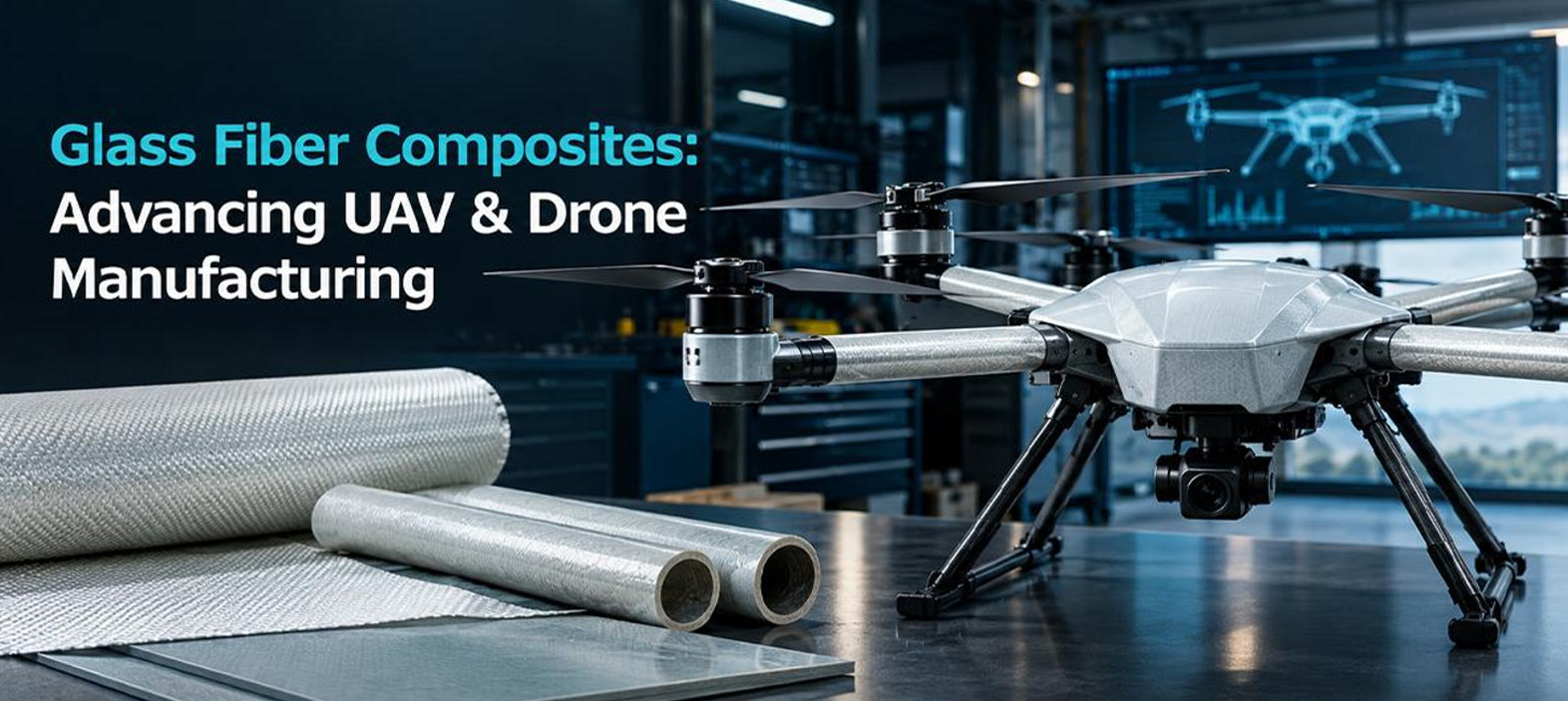
Glass fiber composites are among the materials widely used for UAV and drone components because they offer a useful balance of strength, weight, durability, and cost. Structural booms, arms, fuselage components, housings and enclosures, payload, and sensor support are the most common applications. Unmanned aerial vehicles (UAVs) and drones need to be lightweight, strong, durable, and reliable. As drone designs become more sophisticated, manufacturers are turning to advanced composite materials to meet these demands.
What Are Glass Fiber Composites?
Glass fiber composites are engineered materials made by combining glass fibers with a polymer resin matrix. The glass fibers provide mechanical strength and stiffness, while the resin binds the fibers together, transfers loads, and protects the reinforcement.
Common glass fiber composite forms include:
- Glass fiber reinforced polymer (GFRP) sheets and panels
- Pultruded glass fiber tubes and profiles
- Composite laminates
- Molded structural components
- Custom composite sections
The combination can produce components that are lighter than many traditional metals while providing useful mechanical and environmental performance.
Why Are Glass Fiber Composites Used in Drones?
Drone manufacturers must balance several competing requirements. A UAV needs sufficient structural strength without adding unnecessary weight. It must also withstand vibration, repeated flight loads, weather exposure, and handling.
Glass fiber composites for UAV manufacturing can address several of these requirements.
| Requirement | Benefit of Glass Fiber Composites |
Lightweight construction |
Helps reduce structural weight |
Strength |
Provides good load-bearing capability |
Stiffness |
Supports rigid structural components |
Corrosion resistance |
Does not rust like conventional steel |
Fatigue resistance |
Suitable for repeated loading when properly designed |
Design flexibility |
Can be manufactured in different shapes and orientations |
Cost efficiency |
Often more economical than some advanced carbon fiber solutions |
The exact performance depends on the fiber type, resin system, fiber orientation, laminate design, manufacturing process, and component geometry.
Key Applications of Glass Fiber Composites in UAVs and Drones
1. Drone Frames and Airframes
The airframe is one of the most important structural elements of a UAV. Glass fiber reinforced composites for drone frames can provide the stiffness needed to support motors, electronics, batteries, payloads, and other components.
For certain UAV designs, GFRP structures can provide a practical alternative where extreme stiffness-to-weight performance is not the primary requirement.
2. Structural Tubes and Booms
Pultruded glass fiber tubes are particularly useful for drone structures requiring long, lightweight sections.
They can be used in:
- UAV booms
- Landing structures
- Frame members
- Antenna supports
- Payload supports
- Cross members
Glass fiber pultruded tubes for drones can be manufactured with consistent dimensions and continuous reinforcement, making them suitable for repeatable structural applications.
3. Fuselage Components
Composite panels and molded GFRP components can be incorporated into UAV fuselages and enclosures. Their ability to be formed into different geometries gives designers flexibility when developing aerodynamic and protective structures.
4. Protective Housings and Enclosures
Drone electronics, sensors, communication systems, and other equipment may require protection from environmental exposure and physical impact. Glass fiber composite housings can provide a durable enclosure while helping control component weight.
5. Payload and Sensor Supports
Commercial and industrial UAVs frequently carry cameras, sensors, inspection equipment, mapping systems, and other payloads. Composite structures can be designed to support these systems while limiting unnecessary structural mass.
Glass Fiber vs. Carbon Fiber for UAV Applications
Both glass fiber and carbon fiber composites have important roles in UAV manufacturing. The right choice depends on the application’s performance, weight, stiffness, cost, and electrical requirements.
| Feature | Glass Fiber Composites | Carbon Fiber Composites |
Weight |
Lightweight |
Generally lighter for equivalent structural performance |
Stiffness |
Good |
Very high |
Strength |
Good |
High |
Cost |
Typically lower |
Typically higher |
Corrosion resistance |
Excellent |
Excellent |
Electrical conductivity |
Generally insulating |
Conductive |
Typical advantage |
Cost-effective structural performance |
High stiffness-to-weight performance |
For applications where maximum weight reduction and stiffness are critical, carbon fiber may be preferred. However, glass fiber composites for UAV and drone manufacturing can be an attractive option where cost, durability, electrical insulation, and adequate structural performance are priorities.
What Should Manufacturers Consider When Selecting GFRP?
Choosing glass fiber composites for drone structures requires more than simply selecting a material grade. Engineers should evaluate the complete application.
Important considerations include:
- Required tensile and compressive strength
- Stiffness and deflection limits
- Component weight
- Fiber orientation
- Resin system
- Operating temperature
- Vibration and fatigue requirements
- Environmental exposure
- Manufacturing tolerances
- Production volume and cost
For structural tubes and profiles, dimensions such as outer diameter, wall thickness, fiber orientation, and length can significantly influence performance.
Conclusion
As UAV and drone technology continues to evolve, material selection remains critical to achieving reliable and efficient designs. Glass fiber composites provide a versatile solution for manufacturers seeking lightweight, durable, corrosion-resistant, and cost-effective structural components.
From glass fiber pultruded tubes for UAVs to frames, booms, housings, and payload supports, GFRP can serve a wide range of drone manufacturing requirements. By selecting the right fiber, resin, orientation, geometry, and manufacturing process, engineers can develop composite components tailored to specific UAV performance needs.
Frequently Asked Questions
Q1. Are glass fiber composites suitable for drones?
A. Yes. Glass fiber composites can be used for various UAV and drone components, including frames, structural tubes, booms, housings, supports, and other composite structures.
Q2. Why are glass fiber composites used in UAV manufacturing?
A. They offer a combination of lightweight construction, strength, stiffness, corrosion resistance, design flexibility, and cost efficiency, making them suitable for many UAV applications.
Q3. Are glass fiber composites lighter than aluminum?
A. Glass fiber composites can provide a favorable strength-to-weight ratio compared with aluminum, but the actual weight advantage depends on the specific material grade, component design, and required performance.
Q4. Are glass fiber composites better than carbon fiber for drones?
A. Neither material is universally better. Carbon fiber generally offers higher stiffness-to-weight performance, while glass fiber can provide a more economical solution with good strength, durability, and electrical insulation.