
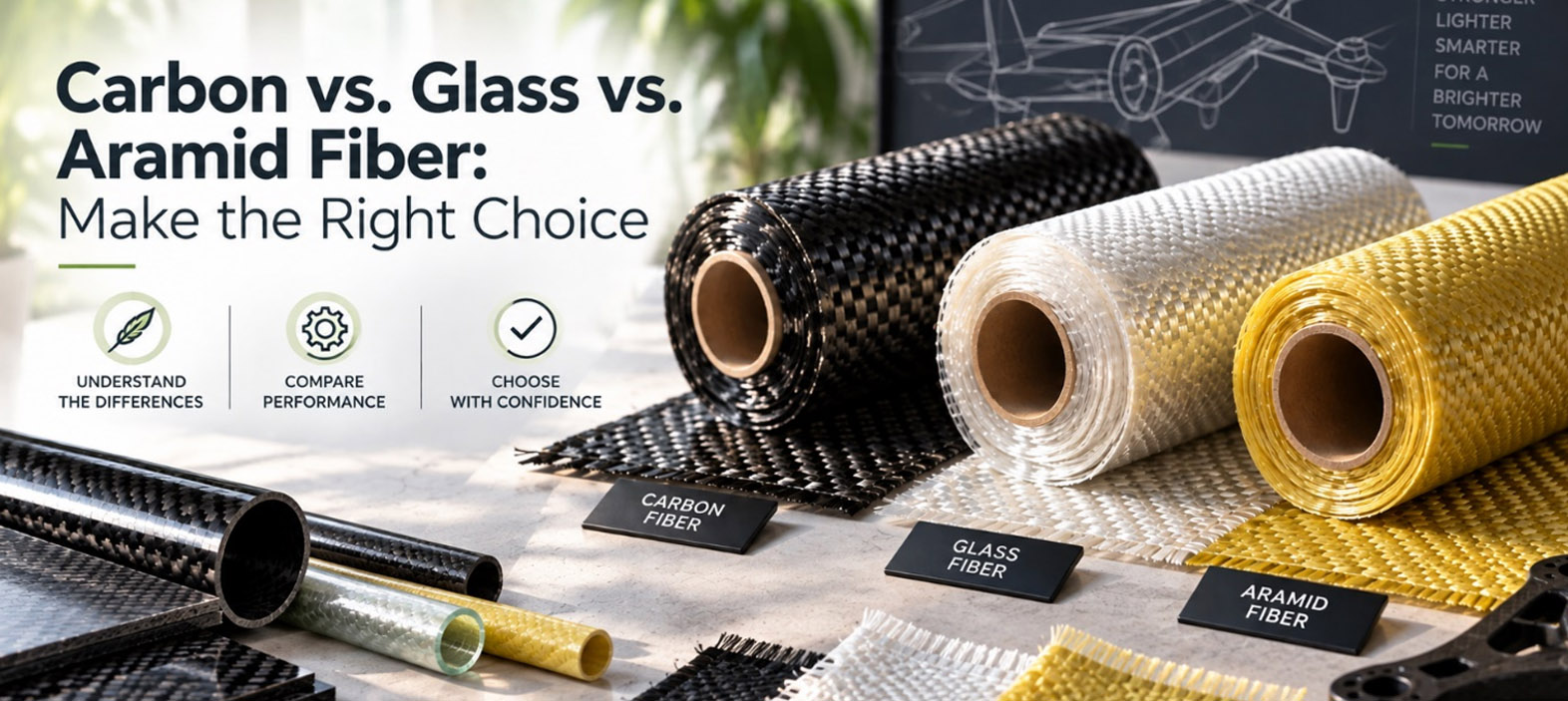
Carbon, glass, and aramid fibers each solve a different engineering problem — stiffness, cost-efficiency, impact resistance. Picking the wrong one is expensive: too much flex damages parts under stress, too much strength wastes budget. Here’s how to tell them apart and choose correctly.
With three composite fibers to choose from and dozens of sub-variants, most sourcing mistakes come down to over-engineering (paying for strength you don’t need) or under-engineering (a part that fails under real-world load).
At NitPro Composites, we work with carbon, aramid, and glass fibers that create strong, reliable structural solutions.
Meet the Big Three Composites
1. Glass Fiber
This super-fine fiber is the most widely used composite, made from silica sand and minerals. It is melted at high temperatures and pulled into tiny threads (thinner than a human hair). These threads get woven into cloth, chopped into mats, or bundled into ropes. Mix them with plastic resin, and you get fiberglass composites — strong, light, and affordable.
Types of glass fiber
- E-glass (electrical glass): This fiber has good electrical insulation, chemical resistance, and is low-cost. It is used in marine, automotive, construction, electronics (e.g., circuit boards), and general composites.
- S-glass (or R-glass/T-glass variants): This has higher tensile strength and stiffness (roughly 20–35% stronger than E-glass, per standard fiber manufacturer datasheets) for high-performance needs like aerospace or sports equipment, at a higher cost.
- Others: C-glass is mainly for chemical resistance; ECR/E-CR is for enhanced corrosion resistance; AR-glass (alkali-resistant for cement), D-glass (low dielectric constant), and specialty variants.
2. Carbon Fiber
High strength and low weight are the key features of carbon fiber. It is made from long; thin strands of pure carbon atoms locked into a strong crystal-like structure.
These filaments are thinner than hair, are woven into fabric, and are locked into place with resin. The resultant material is carbon fiber reinforced plastic (CFRP), which is strong and light.
Carbon fibers are used in aerospace (airplane wings, fuselage sections, satellites), cars and race cars (body panels, chassis, wheels), drones, racing yachts, and also in medical equipment.
3. Aramid Fibers
This fiber is like a bodyguard for the defence force. Aramid is short for “aromatic polyamide.” It’s a synthetic fiber with long, strong molecular chains that lock together tightly. Aramid fibers don’t melt easily, are tough, and are light.
Its superpower is absorbing and spreading out energy from impacts, cuts, and bullets instead of shattering. On a strength-to-weight basis, it’s about five times stronger than steel (based on standard tensile-strength-to-weight benchmarks), yet flexible enough to dissipate shocks rather than crack like more brittle materials. That’s why it shines in protection roles where carbon fiber might snap, and glass fiber might not stop the force as effectively.
Aramid fibers are used in body armor, bulletproof vests, helmets, firefighter suits, racing suits, cut-resistant gloves, and in spacecraft.
Head- to-Head Comparison
Material Properties |
Glass Fiber |
Carbon Fiber |
Aramid Fiber |
Tensile Strength |
High (2,000–3,500 MPa) |
Very High (3,500–7,000 MPa) |
Very High (2,800–3,600 MPa) |
Tensile Stiffness |
Low to moderate |
Very high |
Moderate to low |
Weight/ Density |
Moderate 2.52 g/cm³ |
Light 1.75 to 1.95 g/cm³ |
Lightest 1.45 g/cm³ |
Impact resistance |
Good |
Fair |
Exceptional |
Abrasion Resistance |
Moderate |
Fair |
Excellent |
Relative Cost |
Economical |
Premium High-Performance |
Moderate high |
How to Select the Right Material for Your Build
Choosing the right material for your build is all about matching the fiber’s strengths to what your project actually needs. There’s no universal “best” option—glass, carbon, and aramid each shine in different situations.
Here are some practical ways to decide:
1. Do you need maximum stiffness and low weight?
If keeping the weight low and reducing flexibility are your main goals, Carbon Fiber is an ideal choice. At NitPro Composites, we manufacture carbon fiber tubes, carbon fiber rods, and structural plates designed to stay strong and stable under high loads.
2. Does your part need to survive direct hits and friction?
If your component needs to handle high impact, wear and tear, or strong vibration, pick aramid fiber. It has the ability to absorb and spread energy, helping to protect against sudden damage. Our aramid-reinforced panels and layups are engineered specifically for this kind of high-impact application.
3. Do you have a tight budget or require electrical insulation?
If you need good structural strength at a low cost, glass fiber is the best option available. These fibers are useful where electrical insulation is required. NitPro’s glass fiber composites are built to this exact spec, offering dependable strength without the premium price tag.
Simple Decision Flow
- What’s the main job? (Stiffness → carbon | Impact protection → aramid | Cost + reliability → glass)
- What’s the budget and weight target?
- Will it see impacts, heat, chemicals, or outdoor UV?
- Can you hybridize if needed?
Final Thought
When in doubt, start with glass — it’s the safe, cheap default that rarely embarrasses you. Upgrade to carbon when performance (especially stiffness and weight) is critical. Reach for aramid when the part has to survive punishment.
Whether you need precision-machined carbon fiber plates, custom tubes, or specialized hybrid layups, the engineering team at NitPro Composites is here to bring your design to life.
FAQ
Q 1: Is carbon fiber always better than glass fiber or aramid?
A: No. Carbon fiber is superior for lightweight rigidity, but it is more brittle under extreme impact loads and conducts electricity. If your component requires high impact absorption, aramid is superior. If cost efficiency or electrical insulation is critical, glass fiber is the better choice.
Q 2: Can you mix aramid, carbon, and glass fiber in a single layup?
A: Yes! Using hybrid weaves or layered composite layups allows engineers to combine the advantages of multiple fibers. For example, layering carbon fiber with aramid provides structural stiffness while maintaining high impact protection.
Q 3: Which reinforcement fiber is best for high-vibration or high-wear applications?
A: Aramid fiber is the ideal choice for high-wear and high-impact environments due to its exceptional fatigue endurance, cut resistance, and abrasion resistance.
Q 4: How do I get custom composite components manufactured for my project?
A: Nitpro Composite offers custom manufacturing, pultrusion, roll-wrapping, and precision CNC machining for carbon fiber, glass, and hybrid composite components tailored to your exact specifications. Contact our engineering team for a custom quote.