
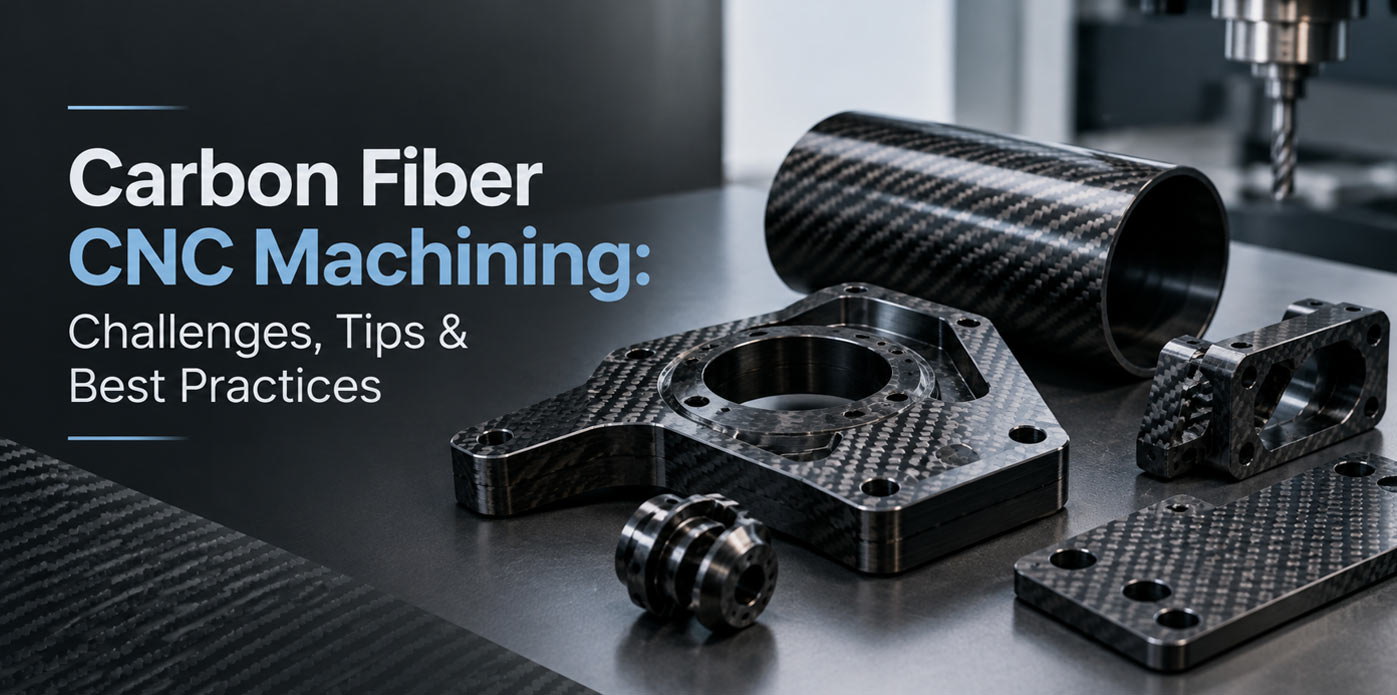
Carbon fiber composites are widely used in aerospace, automotive, robotics, industrial equipment, medical devices, and other advanced engineering applications because of their high strength-to-weight ratio, stiffness, and corrosion resistance. However, manufacturing precision components from these materials requires specialized machining strategies.
CNC machining carbon fiber parts presents unique challenges compared with machining conventional metals. The abrasive nature of carbon fibers, anisotropic material properties, and sensitivity of the polymer matrix to heat can affect dimensional accuracy, surface finish, and component integrity.
For manufacturers using carbon fiber composite materials in their products, understanding the right tooling, cutting parameters, workholding methods, and dust-control measures is essential for achieving consistent quality and production efficiency.
In this guide, NitPro Composites explores the key challenges, practical tips, and best practices for CNC machining carbon fiber parts.
What Is CNC Machining of Carbon Fiber Parts?
CNC machining is a computer-controlled manufacturing process used to cut, drill, trim, mill, and finish components to specified dimensions. When applied to carbon fiber-reinforced polymer (CFRP) components, CNC machining helps manufacturers achieve complex geometries, precise holes, clean edges, and repeatable dimensions.
Unlike metals, CFRP combines strong carbon fibers with a polymer resin matrix. Its machining behavior depends on fiber orientation, laminate structure, resin type, and component thickness.
Common CNC machining operations for carbon fiber composites include:
- CNC milling: Producing slots, profiles, pockets, and complex contours.
- CNC drilling: Creating accurate holes for fasteners, inserts, and assembly points.
- CNC trimming: Removing excess material from molded or cured composite parts.
- CNC routing: Cutting composite sheets, panels, and profiles to required shapes.
- Precision finishing: Improving edge quality and achieving specified dimensional tolerances.
These operations enable manufacturers to integrate lightweight carbon fiber components into demanding industrial applications.
Key Challenges in CNC Machining Carbon Fiber Composites
1. Tool Wear Caused by Abrasive Carbon Fibers
Carbon fibers are highly abrasive, which can rapidly wear conventional cutting tools. As tools deteriorate, manufacturers may experience inconsistent dimensions, rough edges, increased cutting forces, and reduced production efficiency.
Best practice: Use diamond-coated or polycrystalline diamond (PCD) tooling where appropriate. Select carbide tools for suitable applications and monitor tool wear to maintain consistent machining quality.
2. Delamination and Fiber Pull-Out
Delamination occurs when layers within a composite laminate separate during machining. Fiber pull-out and edge fraying can also compromise surface quality and structural integrity.
These defects may result from excessive cutting forces, unsuitable tool geometry, incorrect feed rates, or inadequate support beneath the workpiece.
Best practice: Select tools designed for composite machining, optimize feed and spindle speed through controlled trials, and support the workpiece close to the cutting zone. Use appropriate entry and exit strategies when drilling carbon fiber laminates.
3. Heat Generation and Resin Damage
Although carbon fibers possess excellent thermal properties, the polymer matrix can be sensitive to excessive machining temperatures. Heat buildup may soften, degrade, or damage the resin, affecting surface quality and dimensional stability.
Best practice: Optimize cutting parameters to reduce friction and heat accumulation. Use sharp, suitable tooling, maintain effective chip evacuation, and evaluate appropriate cooling or dry-machining methods against the resin system and process requirements.
4. Hazardous Carbon Fiber Dust
CNC machining carbon fiber composites generates fine dust and particulate matter. Airborne particles can irritate the respiratory system and eyes, while conductive carbon fiber dust can contaminate electrical equipment and create electrical hazards.
Best practice: Implement effective source-capture extraction, suitable filtration, and workplace housekeeping procedures. Assess respiratory and eye protection requirements, and follow applicable occupational safety guidance. Avoid uncontrolled compressed-air cleaning that disperses dust into the workspace.
Best Practices for Precision CNC Machined Carbon Fiber Parts
1. Start with Technical Drawings and Specifications
Precision manufacturing begins with understanding the customer’s requirements. Technical drawings define component dimensions, hole positions, tolerances, surface finishes, and assembly requirements. Reviewing these details before production helps identify potential machining challenges and ensure manufacturability.
2. Select the Right Carbon Fiber Material
Material selection influences machining behavior and final component performance. Manufacturers should consider laminate thickness, fiber orientation, resin system, stiffness, and mechanical loading when selecting carbon fiber sheets, tubes, rods, or custom composite profiles.
3. Optimize Cutting Tools and Machining Parameters
Appropriate cutting tools and carefully established machining parameters help reduce tool wear, minimize delamination, and improve edge quality. Cutting speeds, feed rates, and tool paths should be selected according to the composite material and component geometry.
4. Maintain Dimensional Accuracy and Quality Control
Precision components require consistent inspection throughout manufacturing. Dimensional measurements, surface examinations, and checks against technical drawings help verify that finished parts meet customer specifications and applicable acceptance criteria.
Custom CNC Machined Carbon Fiber Parts as per Technical Drawings
Every industrial application has specific design and performance requirements. Standard components may not always provide the dimensions, geometry, or functionality manufacturers need.
Custom CNC machining of carbon fiber parts enables manufacturers to obtain components designed around their technical specifications.
The process typically involves:
- Requirement assessment: Understanding component applications, operating conditions, quantities, and performance expectations.
- Technical drawing review: Evaluating CAD models, dimensions, tolerances, and machining feasibility.
- Material selection: Identifying suitable carbon fiber composite materials based on structural and functional requirements.
- Precision CNC machining: Manufacturing components using appropriate machining processes and cutting strategies.
- Quality inspection: Verifying dimensions, edge quality, and specified manufacturing requirements.
This drawing-based manufacturing approach is particularly valuable for OEMs seeking custom carbon fiber components manufactured to precise engineering specifications.
Industrial Applications of CNC Machined Carbon Fiber Components
Custom CNC machined carbon fiber parts support numerous manufacturing sectors.
| Industry |
Typical applications |
Aerospace |
Lightweight structural supports, brackets, and composite panels |
Automotive |
Performance components, reinforcements, and custom parts |
Robotics |
Lightweight robotic arms, frames, and equipment supports |
Industrial automation |
Precision fixtures, structural components, and machine parts |
Medical equipment |
Lightweight equipment supports and specialized components |
Choose the Right Manufacturing Partner for Custom Carbon Fiber Parts
Successful carbon fiber CNC machining begins long before the cutting process. It requires an understanding of material properties, application requirements, technical drawings, manufacturing feasibility, and quality expectations.
At NitPro Composites, our expertise as a carbon fiber products manufacturer helps us approach every requirement with a focus on precision, functionality, and application-specific design. We understand the importance of manufacturing carbon fiber components according to customer-provided technical drawings and specifications.
Whether your project involves carbon fiber sheets, tubes, rods, or customized composite components, selecting the right materials and machining approach is essential for achieving reliable results.
Share your technical drawings and manufacturing requirements to explore custom CNC machined carbon fiber solutions for your application. Selecting suitable composite materials and considering machining requirements from the beginning can help create components that meet demanding industrial specifications.
Frequently Asked Questions
1. What is the best CNC machining method for carbon fiber parts?
CNC milling, drilling, routing, and trimming are commonly used for carbon fiber composites. The best method depends on component geometry, laminate construction, required tolerances, production volume, and edge-quality specifications.
2. Which cutting tools are best for CNC machining carbon fiber?
PCD and diamond-coated cutting tools are commonly considered for abrasive carbon fiber composites because of their wear resistance. Carbide tools may also suit specific applications. Selection depends on tooling geometry, laminate structure, machining conditions, and production requirements.
3. How can manufacturers prevent delamination when machining carbon fiber?
Use composite-specific cutting tools, optimize feed rates and spindle speeds, and provide adequate workpiece support. Suitable drilling strategies and backing materials can reduce cutting forces and help minimize delamination, fiber pull-out, and edge damage.
4. Is carbon fiber dust hazardous during CNC machining?
Yes. Carbon fiber machining can release fine airborne particles that irritate the eyes and respiratory system. Effective source-capture extraction, suitable filtration, appropriate protective equipment, and safe housekeeping practices help control occupational exposure and equipment contamination.