
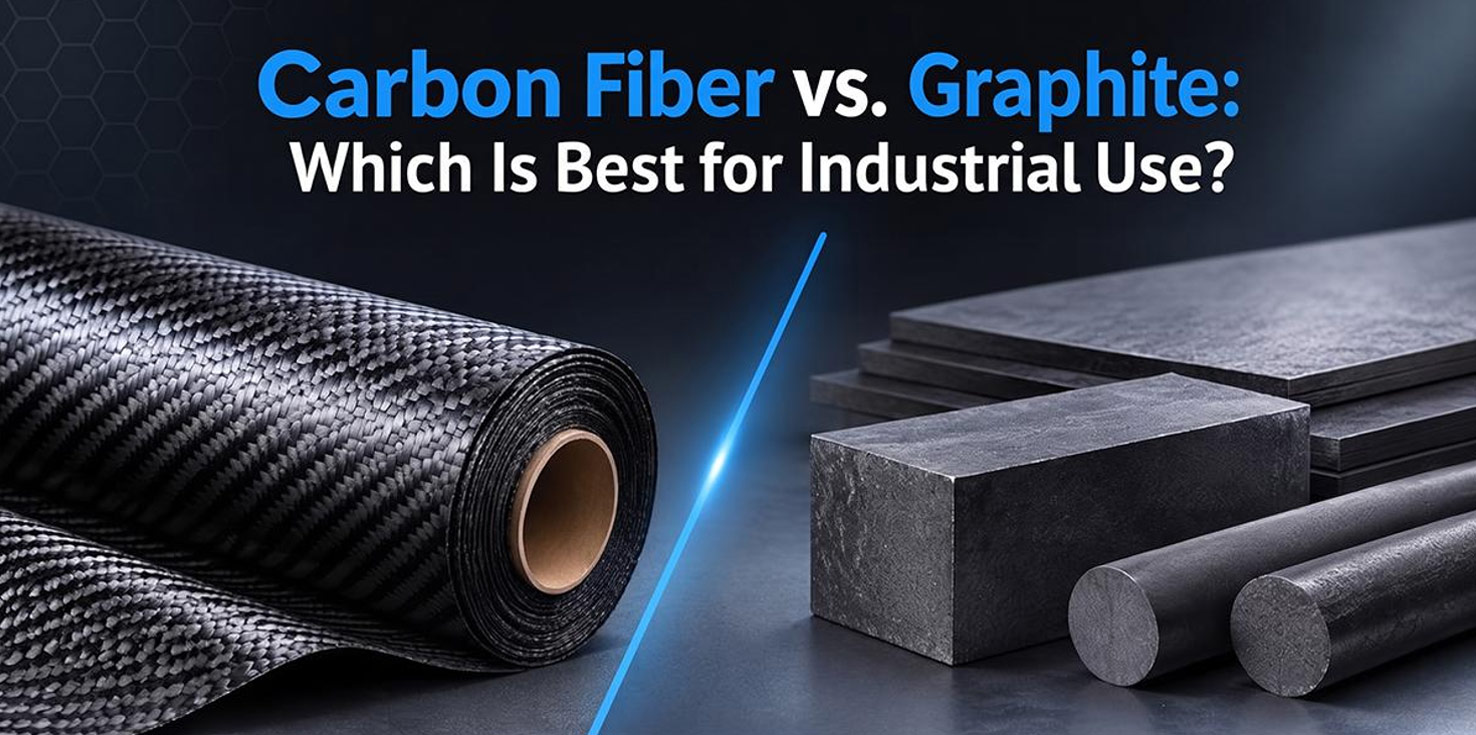
Carbon fiber and graphite are two carbon-based materials used extensively in engineering and manufacturing. Choosing the right material can significantly affect the strength, durability, and performance of industrial components. Both offer valuable properties, but their structures, manufacturing processes, and industrial applications differ significantly.
So, carbon fiber vs. graphite: which material is better for industrial applications? The answer depends on the component’s intended function, operating environment, mechanical loading and performance requirements.
Let’s examine how carbon fiber and graphite compare and where each material offers advantages.
Understanding Carbon Fiber and Graphite
Carbon fiber composites is a high-performance reinforcement material manufactured by processing carbon-rich precursor fibres under controlled conditions. Thousands of fine carbon filaments are combined into tows, which can be arranged in different orientations and incorporated into resin matrices to produce carbon fiber reinforced polymer (CFRP) composites.
Graphite, on the other hand, is a crystalline form of carbon with a layered atomic structure. Its properties include thermal and electrical conductivity, chemical stability and resistance to high temperatures in suitable environments.
An important distinction is that carbon fiber and graphite fiber are sometimes used interchangeably in industry, although they are not technically identical. Graphitization involves additional high-temperature processing that develops greater crystalline ordering in the carbon structure. For industrial material selection, it is also important to distinguish graphite as a bulk solid material from graphite-reinforced or carbon-fiber-reinforced composites.
Also read: https://www.nitprocomposites.com/blog/carbon-fiber-vs-graphite-every-thing-you-need-to-know/
Carbon Fiber vs. Graphite: Key Material Differences
Although both materials are carbon-based, their performance characteristics make them suitable for different engineering requirements.
Property |
Carbon fiber composites |
Graphite |
Structure |
Fibers embedded in a resin matrix |
Crystalline carbon |
Weight |
Low density |
Generally low density |
Strength |
High tensile strength along fiber direction |
Brittle under mechanical loading |
Stiffness |
High and designable through fiber orientation |
High, depending on grade and direction |
Electrical properties |
Conductive, depending on fiber and composite design |
Good electrical conductivity |
Thermal properties |
Depends on fiber, resin and laminate design |
Good thermal conductivity in suitable grades |
Corrosion resistance |
Excellent resistance to many corrosive environments |
Good chemical resistance in suitable environments |
Common applications |
Structural tubes, rods, aerospace and industrial components |
Electrodes, furnace components, seals and thermal applications |
The important consideration is that carbon fiber composites offer directional mechanical properties, while graphite components are selected for properties such as thermal conductivity, electrical conductivity and high-temperature performance.
The Major Decision-Making Differences: Carbon Fiber vs Graphite
Strength-to-Weight Ratio – One of the biggest advantages of carbon fiber composites is their exceptional strength-to-weight ratio. They provide high tensile strength and stiffness without adding significant weight, making them suitable for applications where reducing component weight is essential. For example, pultruded carbon fiber rods and tubes are used in applications requiring structural reinforcement, rigidity and dimensional stability. Their unidirectional fiber arrangement provides high tensile properties along the length of the component.
Graphite, while offering excellent thermal and electrical properties, is generally more brittle and may not be suitable for applications involving substantial mechanical impact or tensile loading. For lightweight industrial structures, precision components and reinforcement applications, carbon fiber composites can therefore offer significant advantages.
Thermal and Electrical Performance – Graphite is widely recognised for its thermal and electrical conductivity. These properties make it suitable for furnace components, electrodes, heat management systems and applications involving high operating temperatures.
Carbon fiber also offers thermal and electrical conductivity, but the performance of a carbon fiber composite depends on the fiber orientation, resin matrix and overall construction. For example, epoxy-based carbon fiber composites have temperature limitations determined partly by the resin’s glass transition temperature. They should not automatically be considered suitable for extreme-temperature environments.
Industrial Applications: Where Does Each Material Work Best?
The choice between carbon fiber and graphite depends on the application’s functional requirements.
Carbon fiber composite applications:
- Aerospace and UAV structures requiring lightweight, rigid components.
- Industrial automation equipment and precision machinery.
- Robotics and structural reinforcement.
- Automotive and motorsport components.
- Sports equipment and specialised engineering products.
- Pultruded carbon fiber rods and tubes for structural applications.
Graphite applications:
- Electrical electrodes and conductive components.
- Furnace fixtures and high-temperature equipment.
- Chemical processing components.
- Mechanical seals and bearings.
- Thermal management and heat transfer systems.
For applications requiring lightweight structural reinforcement, carbon fiber composites are often preferable. Graphite remains valuable where conductivity, thermal performance and chemical stability are the primary considerations.
How to Choose the Right Material for Your Industrial Application
Before selecting carbon fiber or graphite, evaluate the following factors:
- Mechanical requirements: Consider tensile strength, stiffness, impact resistance and expected loading conditions.
- Weight restrictions: Determine whether reducing component weight is a priority.
- Operating temperature: Evaluate thermal exposure and the material’s temperature limitations.
- Environmental conditions: Consider moisture, chemicals, corrosion and UV exposure.
- Manufacturing requirements: Assess dimensional tolerances, fiber orientation, machining requirements and component geometry.
- Project economics: Compare initial material costs with performance, maintenance and expected service life.
So, carbon fiber vs. graphite: which is better? Neither material is universally superior. Carbon fiber composites are particularly suitable for lightweight, high-strength structural applications, while graphite offers advantages in electrical conductivity, thermal management and specialised high-temperature environments. The right choice depends on your engineering priorities, operating conditions and component requirements. Understanding these differences helps manufacturers and designers select materials that deliver reliable performance and long-term value.
NitPro Composites manufactures carbon fiber composite products for industrial and specialised engineering applications. The product range includes pultruded carbon fiber rods and tubes, prepreg tubes and carbon fiber sheets, with manufacturing capabilities supporting different fiber orientations, resin systems, dimensions and surface finishes. We also offer customized composite products based on application requirements and technical specifications.
Whether you require pultruded carbon fiber tubes for structural reinforcement or prepreg tubes for precision engineering applications, selecting the appropriate composite construction is essential for achieving the desired performance.
FAQs
Q1. Is carbon fiber stronger than graphite?
A. Carbon fiber composites offer high tensile strength and stiffness along the fiber direction, making them well suited to structural loads. Graphite is more brittle, so it is generally less suitable for applications involving impact or substantial tensile loading.
Q2. Which material handles high temperatures better?
A. Graphite is widely used in furnace components and high-temperature equipment. Epoxy-based carbon fiber composites are limited by the resin’s glass transition temperature, so they should not automatically be considered suitable for extreme-temperature environments.
Q3. Are carbon fiber and graphite fiber the same thing?
A. Not technically, though the terms are often used interchangeably. Graphitization involves additional high-temperature processing that develops greater crystalline ordering in the carbon structure. Graphite as a bulk solid also differs from carbon-fiber-reinforced composites.
Q4. When should I choose carbon fiber over graphite?
A. Choose carbon fiber composites for lightweight, high-strength structural applications such as rods, tubes and reinforcement. Choose graphite where electrical conductivity, thermal management, chemical stability or high-temperature performance are the primary requirements.